




ATCHAYA M
Updated on
30-07-2026
How e-Invoicing Impacts Customer ITC and Vendor Relationships
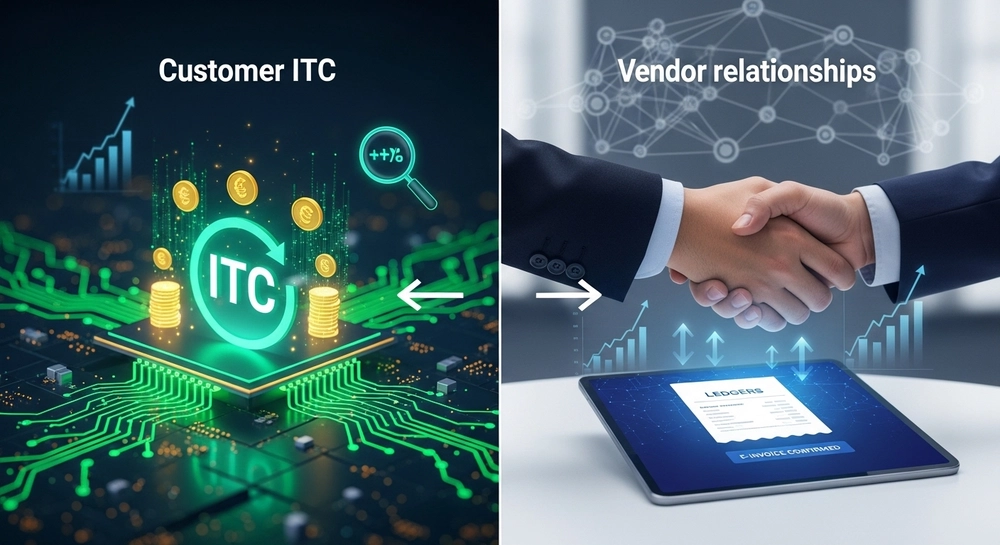
GST invoicing is now more than just billing; it impacts tax reporting, compliance, and the financial position of the seller and the buyer. This link has grown closer since there is now an e-Invoice for all invoices generated through the Invoice Registration Portal (IRP). Each invoice that is generated and registered via the IRP will determine if a buyer can claim the Input Tax Credit (ITC) without issues.
Businesses must ensure accuracy in their invoicing because, while it is primarily an internal issue, inaccurate or delayed e-invoicing can negatively affect a business’s customers, disrupt ITC claims, create reconciliation issues, and, in some cases, hurt the business relationship.
ITC Claims and the Relationship Between e-Invoice and ITC
Businesses can claim ITC on goods/services purchased by tracking the GST they have paid on a purchase, which helps to reduce their total tax liability. However, to claim ITC, the purchased goods/services must be properly documented and accounted for.
Under e-Invoicing, each eligible invoice must be reported to the IRP and given an Invoice Reference Number (IRN) to validate and document the transaction. Once the invoice is properly reported in the appropriate GST returns, the invoice becomes part of the buyer’s ITC.
If the invoice is missing, delayed, or incorrectly reported, the buyer may face difficulty claiming ITC.
How Vendor Invoicing Errors Affect Customers
Customers rely on vendors to issue accurate and timely invoices. Even small invoicing errors can create complications such as:
- Missing invoices in GST return data
- Incorrect tax amounts
- Wrong GSTIN details
- Delay in IRN generation
- Incorrect reporting period
When these issues occur, customers may not see the invoice reflected properly in their tax records. This can delay ITC claims and affect their cash flow.
In some cases, customers may need to follow up repeatedly with vendors to correct the invoice, which creates operational inconvenience.
Delayed IRN Generation and Its Impact
Timely IRN generation is important because it confirms invoice authenticity. If IRN generation is delayed, the invoice may not be included correctly in GST reporting cycles.
Customers may experience:
- Delay in claiming ITC
- Reconciliation mismatches
- Additional internal verification effort
This can lead to frustration, especially when customers depend on timely ITC to manage their tax liability.
Importance of Accurate GSTIN and Invoice Details
One of the most common reasons for ITC issues is incorrect GSTIN entry. If the customer GSTIN is entered incorrectly, the invoice may not link properly to their GST records.
Similarly, incorrect invoice values, tax amounts, or supply classification can create inconsistencies. These errors may require credit notes, debit notes, or amended reporting, which increases compliance workload for both parties.
Ensuring accuracy at the invoice creation stage prevents such complications.
Role of e-Invoicing in Building Vendor Credibility
In today’s compliance-driven environment, customers prefer vendors who maintain clean and reliable invoicing practices. Proper e-Invoicing demonstrates professionalism and strengthens business credibility.
Vendors who consistently generate accurate e-Invoices help customers:
- Claim ITC without delays
- Maintain smooth GST compliance
- Reduce reconciliation effort
- Avoid compliance risk
Over time, this builds trust and strengthens long-term business relationships.
Customer Reconciliation and Compliance Confidence
Most businesses perform periodic reconciliation between purchase records and GST data. When vendor invoices are accurate and properly registered, reconciliation becomes straightforward.
However, frequent invoicing errors from vendors increase reconciliation effort and create uncertainty. Customers may need to verify each transaction manually, which consumes time and resources.
Consistent and accurate e-Invoicing helps maintain smooth financial and compliance workflows for both sides.
Business Impact Beyond Compliance
The effect of invoicing accuracy goes beyond tax reporting. Reliable invoicing practices influence:
- Vendor reputation
- Customer satisfaction
- Payment cycles
- Long-term business relationships
Customers are more likely to continue working with vendors who maintain strong compliance discipline.
Why Structured e-Invoicing Practices Matter
A structured e-Invoicing process helps ensure that invoices are:
- Generated accurately
- Registered on time
- Reported correctly in GST returns
- Linked properly to customer records
This reduces compliance risk and strengthens operational efficiency.
Conclusion
e-Invoicing plays a critical role not only in GST compliance but also in maintaining healthy business relationships. Since customers depend on vendor invoices to claim Input Tax Credit, accuracy and timeliness are essential.
By following disciplined e-Invoicing practices, businesses can ensure smooth ITC flow for customers, reduce reconciliation issues, and build long-term trust. Reliable invoicing strengthens both compliance stability and business credibility, making it an essential part of modern GST operations.