




ATCHAYA M
Updated on
06-03-2026
How e-Invoicing Improves Billing Discipline and Data Accuracy
The majority of businesses considered invoicing to be a routine administrative function in the past. After an invoice was produced and sent to the customer, the process was thought to be complete. However, now there is new legislation, specifically GST, and the introduction of digital compliance systems, like e-invoicing, means invoicing has now become much more structured and accountable.
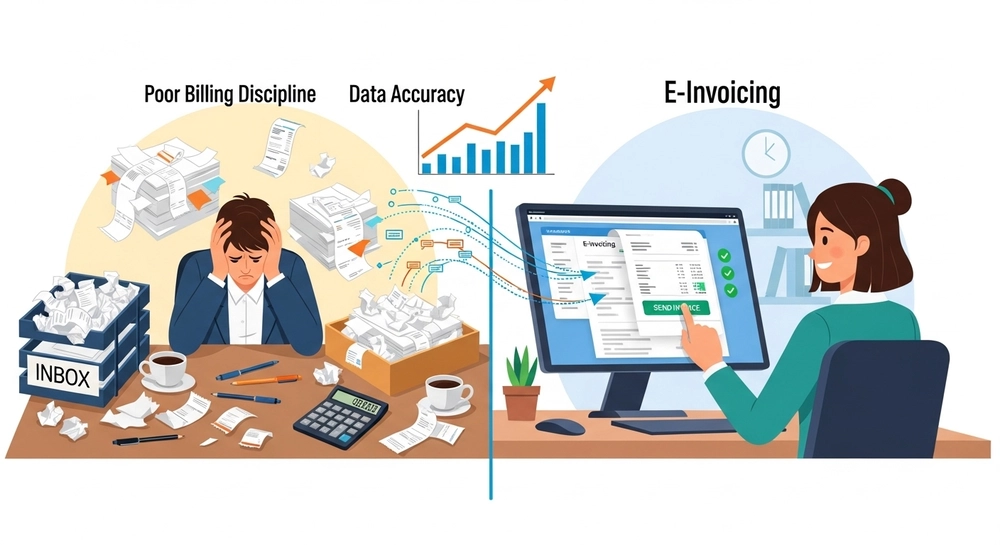
While several companies initially viewed e-invoicing as just another compliance requirement, many organizations have come to understand that it is beneficial for them in terms of operational efficiency. One immediate benefit of e-invoicing is that it encourages better discipline in the way billing is performed and improves the quality of the invoice data.
Encouraging Accuracy through Structured Data Entry
Many traditional invoicing processes allowed an organization a high degree of flexibility. Businesses would normally issue invoices with different formats, often with incomplete or inconsistent data. Although these formats were acceptable for business purposes internally, they generally presented issues for external purposes, including how to report tax, reconcile documents and complete audits.
e-Invoicing requires an invoice to comply with a defined structure before it can be registered with the Invoice Registration Portal (IRP). Certain fields, including GSTIN, invoice number, amount of tax, HSN or SAC codes, and details of the supply, must all be entered accurately based on the data structure.
Because an invoice is validated before the generation of an IRN, businesses are encouraged to maintain accurate records from the outset of(invoice) production.
Improved Billing Discipline Across Teams
In many organizations, invoicing responsibilities are shared across departments such as sales, accounts, and operations. Without a clear system, inconsistencies can arise when multiple teams handle billing tasks.
The structured nature of e-Invoicing helps create consistent billing practices across the organization. Teams begin to follow standardized procedures for:
- Creating invoices
- Maintaining customer records
- Applying tax classifications
- Recording transaction details
Over time, this leads to better coordination between departments and fewer errors during invoice preparation.
Reduction in Manual Errors
Manual invoicing processes often lead to small but significant mistakes. These may include incorrect tax calculations, wrong GSTIN entries, duplicate invoice numbers, or mismatched invoice values.
Because e-Invoicing systems validate key fields before registration, many of these errors are identified early in the process. This helps businesses correct mistakes before the invoice becomes part of the official compliance record.
As a result, businesses experience fewer corrections, fewer credit notes, and fewer reconciliation issues.
Better Customer Data Management
Accurate customer information plays a crucial role in GST compliance. Incorrect GSTIN numbers, incorrect addresses, or wrong state codes can create problems in tax reporting and Input Tax Credit claims.
The requirements of e-Invoicing encourage businesses to maintain clean and up-to-date customer master records. When customer data is accurate, invoices are generated correctly and reported consistently across GST returns.
This also improves the overall reliability of the organization’s financial data.
Consistency in Invoice Numbering and Documentation
Another area where e-Invoicing improves discipline is invoice numbering and documentation. Businesses must follow clear numbering patterns and maintain chronological invoice records.
This reduces the risk of:
- Duplicate invoices
- Missing invoice numbers
- Untracked transactions
Maintaining consistent invoice records helps businesses manage audits and financial reviews more confidently.
Simplified Reconciliation Processes
When invoice data is accurate and standardized, reconciliation becomes much easier. Businesses can quickly match invoices with accounting records, GST returns, and customer confirmations.
Instead of spending hours identifying mismatches or correcting records, finance teams can focus on monitoring compliance and improving financial reporting.
This saves time and reduces operational stress during return filing periods.
Long-Term Operational Benefits
Over time, the discipline introduced by e-Invoicing helps businesses develop stronger financial processes. Structured invoicing leads to:
- Better financial transparency
- Improved tax compliance
- Faster internal audits
- More reliable reporting
What initially appears to be a compliance requirement eventually becomes an operational advantage.
Conclusion
e-Invoicing is often viewed as a regulatory change, but its impact goes far beyond compliance. By requiring standardized invoice structures and validated data, it encourages businesses to adopt better billing discipline and maintain more accurate records.
Organizations that embrace these structured processes benefit from improved data accuracy, smoother reconciliation, and stronger financial control. Over time, e-Invoicing becomes not just a compliance tool but an important step toward more organized and efficient business operations.