
PUGALENTHI
Updated on 30-07-2026
Navigating India's Goods and Services Tax (GST) represents a major challenge to entrepreneurs attempting to maximize their financial working capital efficiency. An important provision of GST is the ability for the Input Tax Credit (ITC) to be claimed against the total liability of GST paid for all goods and/or services purchased. However, there are limitations to claiming ITCs through the concept of blocked credits, which are detailed through Section 17(5) of the GST Act. These blocked credits limit a company's eligibility to claim ITCs resulting from the purchased item or service. As a result, companies who are limited by blocked credits will typically experience diminished financial and operational efficiencies. This article reviews and provides insight into the blocked credits concept, its effect upon companies, typical mistakes leading to blocked credits as well as recommended practices to ensure compliance with GST legislation.
ITC serves as a fundamental aspect of GST, designed to alleviate the cascading tax burden and promote a seamless flow of goods and services without the hindrance of cumulative tax liabilities. In essence, ITC allows businesses to claim the tax paid on procurements (input GST) against their output GST liabilities, thereby minimizing the overall tax outflow. This not only aids in reducing the cost of goods and services but also bolsters a business's cash flow management, enabling resources to be directed towards growth and expansion.
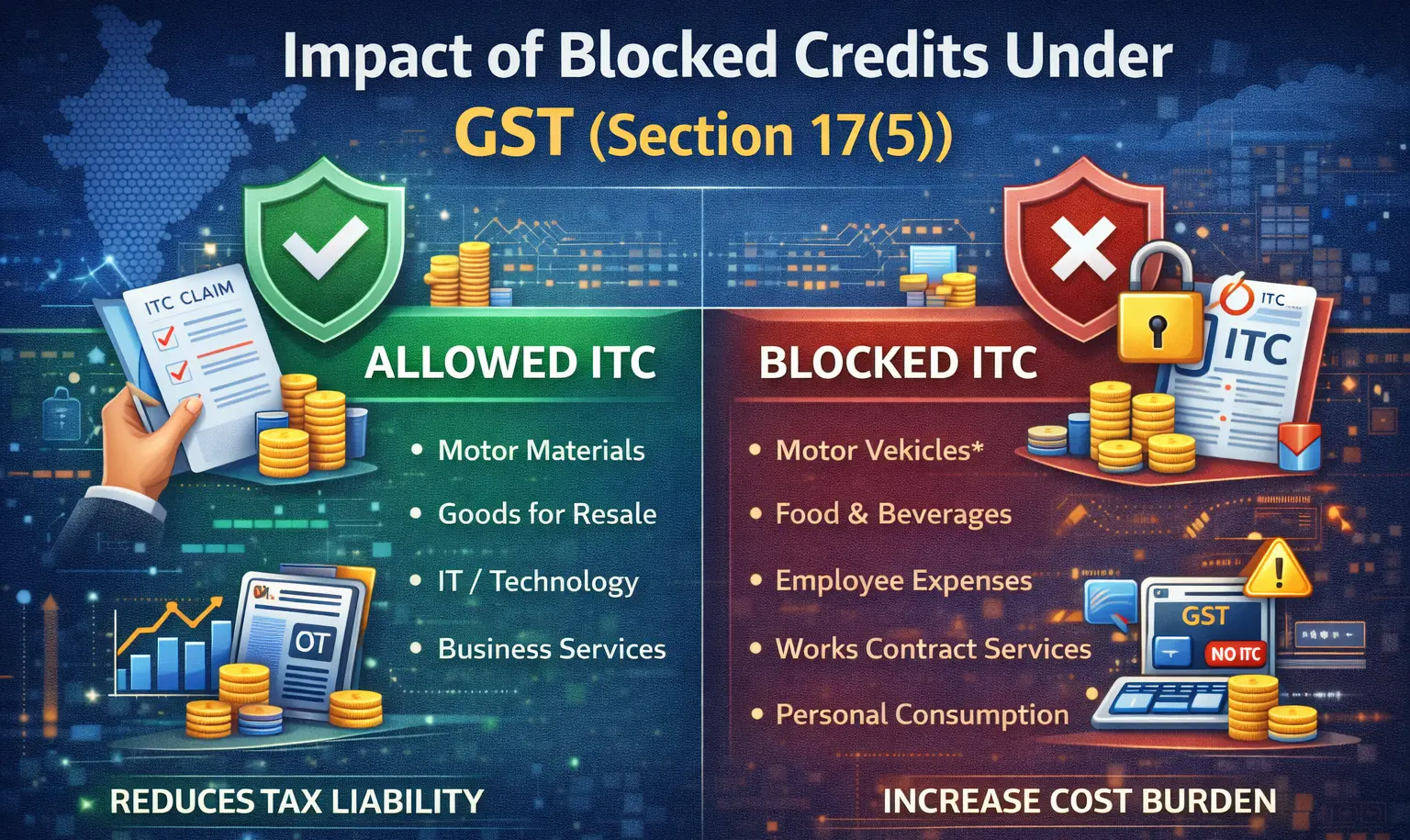
While ITC is a valuable mechanism to counterbalance tax burdens, not all expenses qualify for credit under GST. Section 17(5) explicitly categorizes 'blocked credits,' disallowing ITC on specific items, regardless of a business's sector or operational nature. Compliance with these provisions is crucial to avoid legal repercussions, maintain accuracy in financial reporting, and ensure effective tax management.
The financial implications of blocked credits are significant; they directly increase the operational costs of businesses, as they must bear the GST expense without offset benefits. The additional tax liability can strain cash flows, particularly for small and medium enterprises with limited resources. From a compliance perspective, accurately identifying and classifying expenses that fall under blocked credits is imperative to avoid penalties and maintain accurate tax returns.
Among the common mistakes, businesses often inaccurately claim ITC on expenses that are classified as blocked credits due to ignorance or misinterpretation of the law. To mitigate such errors:
Ensuring compliance with GST laws regarding blocked credits necessitates vigilance and strategic planning:
Blocked credits under Section 17(5) of GST create both financial and compliance difficulties for businesses throughout India. The ability to effectively manage your ITC needs to be based upon a thorough understanding of blocked credits as they relate to GST regulation; therefore, your knowledge of these regulations is critical to your understanding of the complexities associated with the overall process. Companies can take advantage of expert input and implement best practices to maximize their ITC claims, which will have a positive impact on their cash flow and operational efficiency. Enriching your knowledge and adjusting to continuously changing GST regulations are also key points; therefore, it is paramount for you to seek professional assistance when it comes to developing effective tax management strategies.
LEDGERS assists with compliance relating to GST through the integration of reconciliations into your accounting processes to allow the speedy identification of errors in records prior to incurring any penalties or interest. LEDGERS allows you to automate the process of synchronizing your GSTN data and tracking invoices on an invoice-by-invoice basis eliminating the need for manual corrections and the time-consuming process of verifying transactions at the end of a reporting period through the use of automatic validations from the system to facilitate revenue compliance activities.
