
VAIRAVAN K
Updated on 30-07-2026
Most businesses treat bank reconciliation like a chore. The ones that thrive treat it like a conversation.
Let's be honest. When most business owners hear "bank reconciliation," their eyes glaze over. It sounds like the kind of task you hand off to your accountant, forget about until month-end, and only care about when something goes wrong. But here's the thing: if you're running a business and you're not paying attention to your reconciliation process, you're essentially flying blind with your finances. And that's a dangerous place to be.
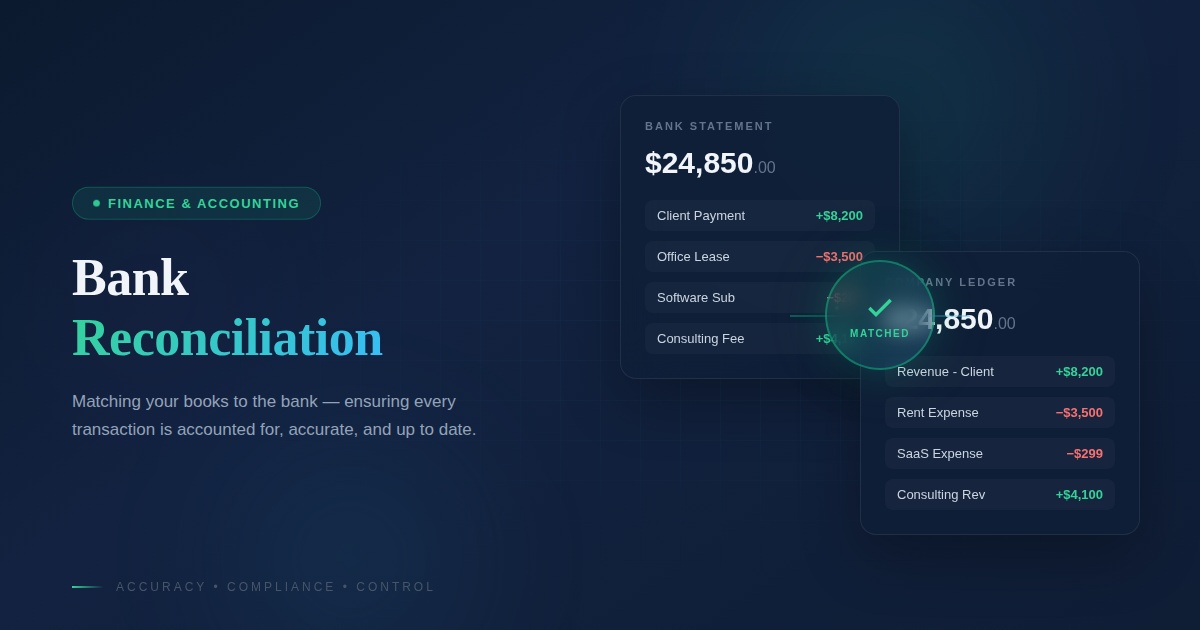
Bank reconciliation, at its core, is the process of making sure your internal financial records match what your bank actually shows. Simple concept. But the implications of doing it well, or poorly, ripple through every corner of your business.
Think of your bank statement and your books as two people telling the same story. They should agree. When they don't, that discrepancy is a signal. Something happened that deserves your attention.
Maybe it's a vendor payment that cleared late. Maybe it's a duplicate charge you didn't notice. Or maybe, and this happens more often than people admit, it's fraud. Small, creeping fraud that goes undetected for months because no one was comparing the numbers closely enough.
Regular, thorough reconciliation isn't just good accounting practice. It's a frontline defense. The longer discrepancies go unnoticed, the more expensive they become to resolve, financially and reputationally.
For decades, reconciliation looked the same everywhere: spreadsheets, printed statements, a highlighter, and way too much time spent squinting at rows of numbers. It worked, sort of. But it was slow, error-prone, and honestly exhausting.
Today, smart finance teams are doing it differently. Modern accounting platforms can pull your bank feeds automatically, match transactions against your records in real time, and flag anomalies before they become problems. What used to take a whole Friday afternoon can now happen continuously in the background, quietly keeping your books clean without you lifting a finger.
This isn't about replacing human judgment. It's about freeing up human judgment for what actually matters: understanding why something doesn't match, not just that it doesn't.
A well-run reconciliation process isn't just about catching mistakes. It's about maintaining a real-time pulse on your cash flow. Here's what it looks like when businesses get it right:
Frequency matters. Monthly reconciliation is the bare minimum. High-volume businesses, especially in retail, hospitality, or e-commerce, should be reconciling weekly or even daily. The longer you wait, the harder it is to trace discrepancies back to their source.
Automation reduces noise. When your accounting system is connected to your bank feed, routine matches happen automatically. Your team only sees what needs a second look: unmatched transactions, unusual amounts, or timing differences that need explanation.
Documentation builds trust. Every reconciled period should leave a clear paper trail. Not just for auditors, but for you. So that six months from now, if a question comes up about a specific transaction, you can answer it in minutes, not days.
Here's a perspective shift that changes how you think about this process: bank reconciliation isn't just about accuracy. It's about clarity.
When your books are reconciled regularly and accurately, you always know where you stand. You can make faster decisions about hiring, investment, and credit. You can spot seasonal patterns in your cash flow. You can walk into a lender's office or an investor meeting with confidence, because your numbers are clean.
On the flip side, businesses with reconciliation gaps often discover the problem at the worst possible time: when they're trying to close a funding round, respond to a tax audit, or understand why cash is tight despite strong sales. Cleaning up messy books under pressure is expensive, stressful, and entirely avoidable.
The good news is that getting your reconciliation process in shape has never been more accessible. Cloud-based accounting platforms today are designed to make this seamless, connecting directly to your bank accounts, categorizing transactions intelligently, and giving you a dashboard view of where your books stand at any moment.
If you're ready to take your reconciliation process from reactive to proactive, explore what Ledgers' bank reconciliation features can do for your business. See how automating this one process can transform the way you manage your finances.
Bank reconciliation will never be glamorous. But it is foundational. It's the quiet work that keeps everything else honest: your cash flow projections, your tax filings, your investor reports, your peace of mind.
Smart finance isn't just about big strategy moves and bold investments. A lot of it comes down to doing the fundamental things consistently and well. Reconciliation is one of those things. And once you build the habit, or better yet automate it, you'll wonder how you ever ran your business without it.
