




HARI KRISHNAN S
Updated on
30-07-2026
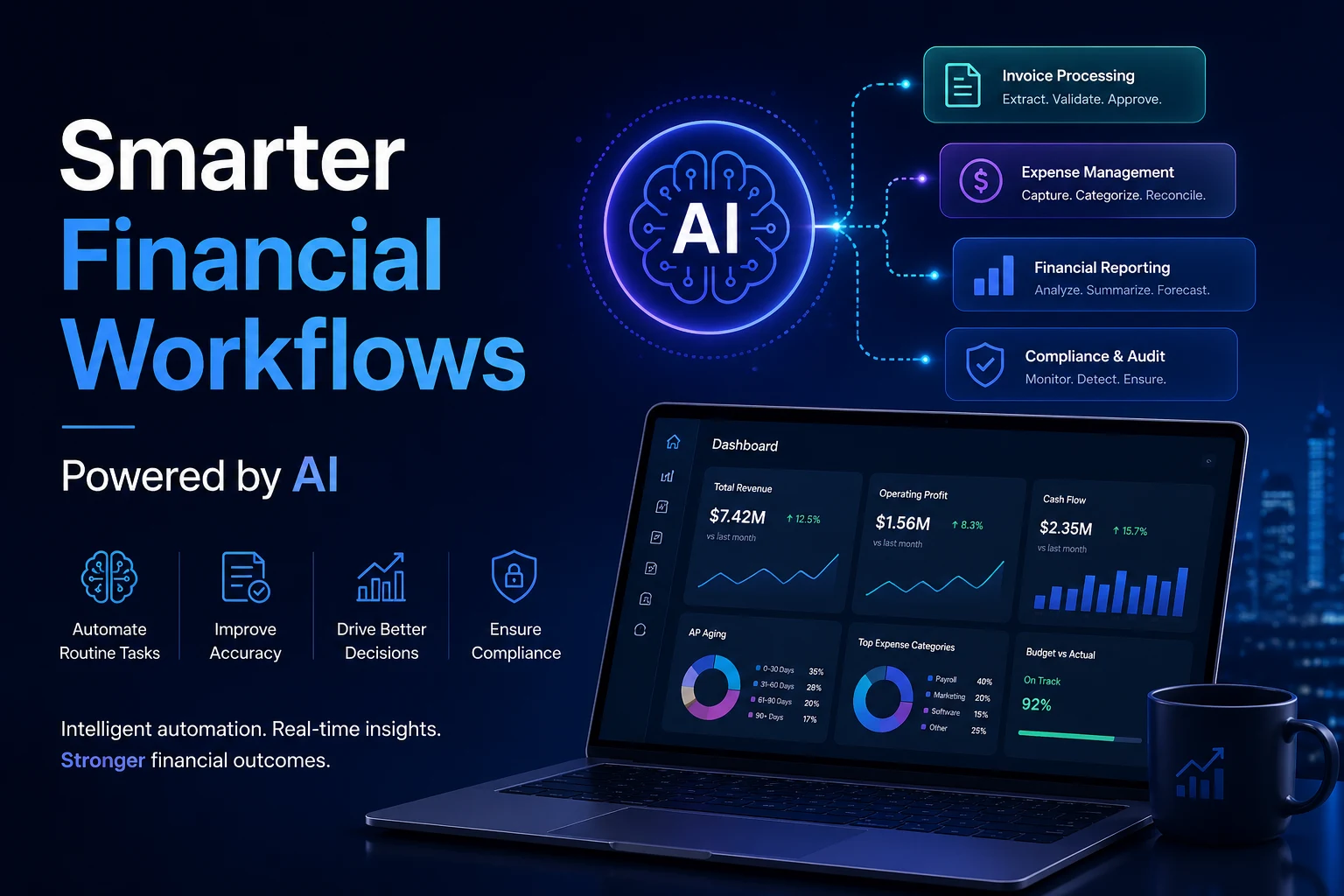
Smarter Financial Workflows Powered by AI
The financial services industry passes through a profound transformation. Artificial intelligence is no longer a futuristic concept– it is actively reshaping how organizations manage currency, assess risk, and serve customers. By automatic reconciliation predictive analytics, AI- powered workflows deliver efficiency gains that seemed impossible. A few years ago.
The Evolution of Financial Operations
Traditional financial workflows Functions for a long time manual data entry, Frequent reconciliation tasks, and period- consuming compliance checks. Finance team uses. Countless hours Transfer information between systems, validate transactions and generate reports. This approach Not just dysfunctional– it suffers. Human error And leaves little room to strategic thinking. AI changes This equation basically. By automating routine tasks and augmenting human decision- making with machine intelligence, Financial workflows are becoming faster, more accurate and significantly more scalable.
Key Areas of AI Impact
Accounts Payable and Receivable
Invoice processing has been revolutionized by AI-powered optical character recognition and natural language processing. Systems can now extract data from invoices in multiple formats, match them against purchase orders, flag discrepancies, and route approvals automatically. What once took days now happens in minutes, and error rates have plummeted.
Financial Planning and Analysis
Predictive models analyze historical patterns, market conditions, and business metrics to generate accurate forecasts. AI can identify trends that human analysts might miss, simulate multiple scenarios simultaneously, and adjust projections in real-time as new data arrives. This transforms FP&A from a backward-looking reporting function into a forward-looking strategic partner.
Fraud Detection and Risk Management
Machine learning algorithms excel at pattern recognition across massive datasets. They can detect anomalies indicating fraudulent transactions, assess credit risk with greater precision, and monitor compliance violations continuously. Unlike rule-based systems, these models adapt and improve as they encounter new patterns.
Cash Flow Optimization
AI-driven treasury management systems predict cash positions with remarkable accuracy, optimize working capital allocation, and recommend the best timing for payments and collections. They analyze payment patterns, seasonal trends, and external factors to ensure liquidity while maximizing returns on idle cash.
The Efficiency Multiplier
The real power of AI in finance isn't just automation—it's the multiplication of human capability. When routine tasks are handled by intelligent systems, finance professionals can focus on analysis, strategy, and relationship-building. A CFO's team becomes more valuable when they're interpreting insights rather than compiling spreadsheets.
Organizations implementing AI-powered financial workflows report dramatic improvements: monthly close cycles shortened by 40-60%, invoice processing costs reduced by up to 80%, and forecast accuracy improvements of 20-30%. Perhaps more importantly, they report higher employee satisfaction as teams shift from tedious manual work to more engaging analytical tasks.
Intelligent Document Processing
Modern financial operations handle an enormous volume of documents—contracts, statements, receipts, tax forms, regulatory filings. AI-powered document intelligence can categorize these automatically, extract relevant data points, validate information against other sources, and even draft responses or summaries. This capability alone eliminates bottlenecks that previously required dedicated teams.
Real-Time Decision Support
Traditional financial analysis operates on historical data, often weeks or months old. AI enables real-time monitoring and alerts. Systems can flag unusual spending patterns as they occur, notify managers when budgets approach thresholds, or recommend adjustments to pricing strategies based on current market conditions. This shift from reactive to proactive management represents a fundamental improvement in how organizations control finances.
Integration and Interoperability
Modern AI financial systems don't operate in isolation. They integrate with enterprise resource planning platforms, customer relationship management systems, banking platforms, and data warehouses. This creates a unified financial nervous system where information flows seamlessly, eliminating data silos and ensuring everyone works from a single source of truth.
Challenges and Considerations
Implementing AI-powered financial workflows isn't without challenges. Data quality remains paramount—algorithms are only as good as the data they're trained on. Organizations must address data governance, ensure regulatory compliance, and maintain human oversight for critical decisions. There's also a learning curve as teams adapt to new tools and processes.
Change management becomes crucial. Finance teams need training not just on new systems, but on how to work alongside AI—knowing when to trust automated recommendations and when to apply human judgment. The most successful implementations view AI as augmentation rather than replacement.
The Path Forward
The trajectory is clear: AI will become increasingly central to financial operations. As models become more sophisticated and datasets grow richer, the capabilities will expand. We're already seeing early applications of generative AI in financial reporting, where systems can draft management commentary, create visualizations, and even respond to stakeholder questions about financial results.
The competitive advantage will belong to organizations that embrace these technologies thoughtfully—automating what can be automated, augmenting human capabilities where judgment matters, and continuously refining processes based on what the data reveals.
Conclusion
Smarter financial workflows Capability municipality AI represents more than incremental improvement. They enable. A fundamental reimagining what kind financial operations By to terminate the function manual drudgery, Increased accuracy and rendering real- time intelligence, AI allows. Finance teams To stay true strategic partners I driving business success. Question Organizations no longer have a mandate to adopt. AI I financial workflows, But how soon? they can implement it effectively. Decisive movers will discover itself. Leaner operations, Better insight and finances teams Focused But value creation Transaction processing instead. The future of finance Is intelligent, Automated and increasingly strategic. The transformation is already underway.