




MONISHA D
Updated on
24-03-2026
Understanding Credit Note and Debit Note in GST
In GST-based business transactions, errors, returns, or pricing changes are common. To manage these adjustments accurately, businesses use credit notes and debit notes. These documents help correct invoices and ensure proper tax compliance. With Ledgers Accounting Software, businesses can easily create, track, and manage credit and debit notes while maintaining accurate GST records and seamless reconciliation.
Introduction
In real-world transactions, the value or tax amount in an invoice may change due to returns, discounts, or pricing errors. Instead of modifying the original invoice, GST requires businesses to issue credit notes or debit notes to reflect these changes.
Ledgers simplifies this process by enabling businesses to generate GST-compliant notes, link them to invoices, and automatically update financial records-ensuring accuracy and compliance.
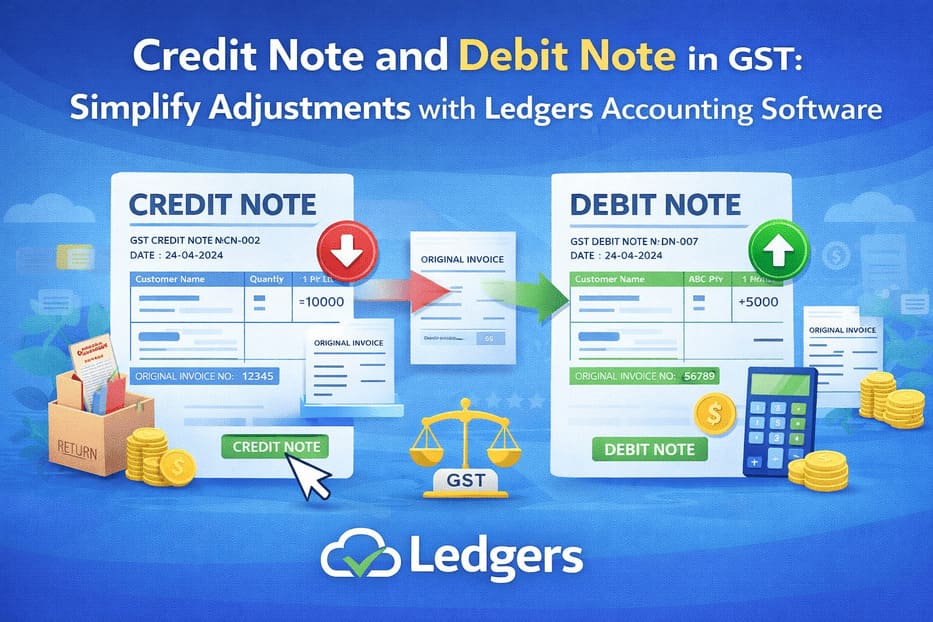
What are Credit Notes and Debit Notes in GST?In the realm of GST, credit notes and debit notes are integral components, often used to adjust or rectify transactions post-invoice generation. Let's break down the basics:
- Credit Note: Issued by a supplier to a buyer, a credit note reduces the value of goods or services supplied. It is typically appropriate for rectifying errors such as overbilling or returns of goods.
- Debit Note: In contrast, a debit note is issued when additional charges apply to a transaction. This could be due to price adjustments or additional quantities of items provided than originally invoiced.
These notes play a critical role in ensuring the financial statements of businesses reflect accurate transactions, ultimately aiding in compliance with GST regulations.
When to Issue a Credit Note
A credit note is typically issued in the following situations:
- Goods are returned by the customer
- Excess amount was charged in the invoice
- Post-sale discounts are provided
- Incorrect tax rate or quantity was applied
Credit notes reduce the taxable value and GST liability, making them essential for correcting overbilling.
When to Issue a Debit Note
A debit note is used when the invoice value needs to be increased:
- Additional goods or services are provided
- Underbilling in the original invoice
- Incorrect (lower) tax rate applied
- Additional charges like freight or service fees
Debit notes increase the taxable value and GST liability, ensuring accurate billing.
How Ledgers Simplifies Credit & Debit Note Management
Ledgers Accounting Software provides a seamless way to manage invoice adjustments.
Key Features:
-
Easy Creation:
Generate credit and debit notes in just a few clicks
-
Invoice Linking:
Automatically link notes to original invoices for better tracking
-
GST Compliance:
Ensure proper tax adjustments as per GST rules
-
Audit Trail:
Maintain complete records of all changes and transactions
-
Return Filing Support:
Export data for GST returns like GSTR-1 easily
How It Works in Ledgers
Ledgers provides a simple workflow for managing credit and debit notes:
- Select the Invoice
Choose the original invoice that needs adjustment
- Create Credit/Debit Note
Enter required details such as amount, reason, and tax
- Auto Tax Calculation
GST is calculated automatically based on changes
- Link & Save
Attach the note to the original invoice
- Report & File Include the details in GST returns seamlessly
Benefits of Using Ledgers for Adjustments
Accurate GST Compliance
-
Ensure proper tax adjustments as per GST regulations
-
Avoid penalties due to incorrect reporting
Automated Accounting
-
Automatically update receivables and payables
-
Reduce manual errors and duplication
Real-Time Tracking
-
Monitor all adjustments in one dashboard
-
Access detailed reports instantly
Professional Documentation
-
Maintain clear and transparent transaction records
-
Improve trust with customers and auditors
Utilizing Ledgers Accounting Software
Incorporating an advanced accounting solution such as Ledgers can streamline the process of handling credit and debit notes within the GST framework. Here's why opting for an intuitive software solution is beneficial:
- Automated Calculations: Software like Ledgers executes automatic recalculations in real-time, reducing manual errors associated with human calculations.
- Efficient Record-Keeping: With comprehensive digital records, you can easily track, manage, and retrieve credit and debit note information as required.
- Integration Capabilities: Ledgers integrates with your existing systems, allowing seamless data management across all transactions.
- Compliance Assurance: Stay updated with GST compliance by automatically generating documents that adhere to the latest regulations.
Why Accurate Credit and Debit Note Management is Vital
Proper handling of credit notes and debit notes is pivotal to avoid discrepancies in tax calculations and maintain accurate financial records. Here's what's at stake:
- Legal Compliance: Mismanagement of these documents can lead to non-compliance with GST laws, potentially resulting in penalties.
- Financial Accuracy: Ensures your financial statements accurately depict your business transactions, leading to better financial decision-making.
- Customer Relations: Efficient issuance and handling of these notes can improve trust and transparency with your clients and suppliers.
Improve Financial Control with Automation
Credit and debit notes are not just correction tools-they are essential for financial accuracy. Ledgers integrates these adjustments directly into your accounting system, helping you:
- Maintain clean and error-free books
- Simplify reconciliation
- Improve financial visibility
- Ensure audit readiness
Scalability for Growing Businesses
Ledgers is designed to handle increasing transaction volumes and complex workflows:
- Manage multiple invoices and adjustments
- Support multi-branch operations
- Adapt to evolving GST rules
The GST framework is continuously evolving, requiring businesses to stay abreast of new rules and regulations. Recent updates and adjustments emphasize the importance of integrating advanced accounting software for managing credit and debit notes:
- Regulatory Updates: The government periodically updates GST compliance requirements, necessitating businesses to adapt swiftly.
- Digital Initiatives: The push for digital transactions has made it imperative for businesses to maintain electronic records meticulously.
- Simplification of Processes: Recent measures aim to streamline GST processes through simplified forms and adjustments, secured by accurate note management.
Conclusion
Credit notes and debit notes play a vital role in maintaining accurate GST records and financial transparency. Managing them manually can be complex, but Ledgers Accounting Software simplifies the entire process with automation, real-time tracking, and seamless integration.
By using Ledgers, businesses can handle invoice adjustments efficiently, stay compliant with GST regulations, and maintain complete control over their financial operations.