




HARI KRISHNAN S
Updated on
08-04-2026
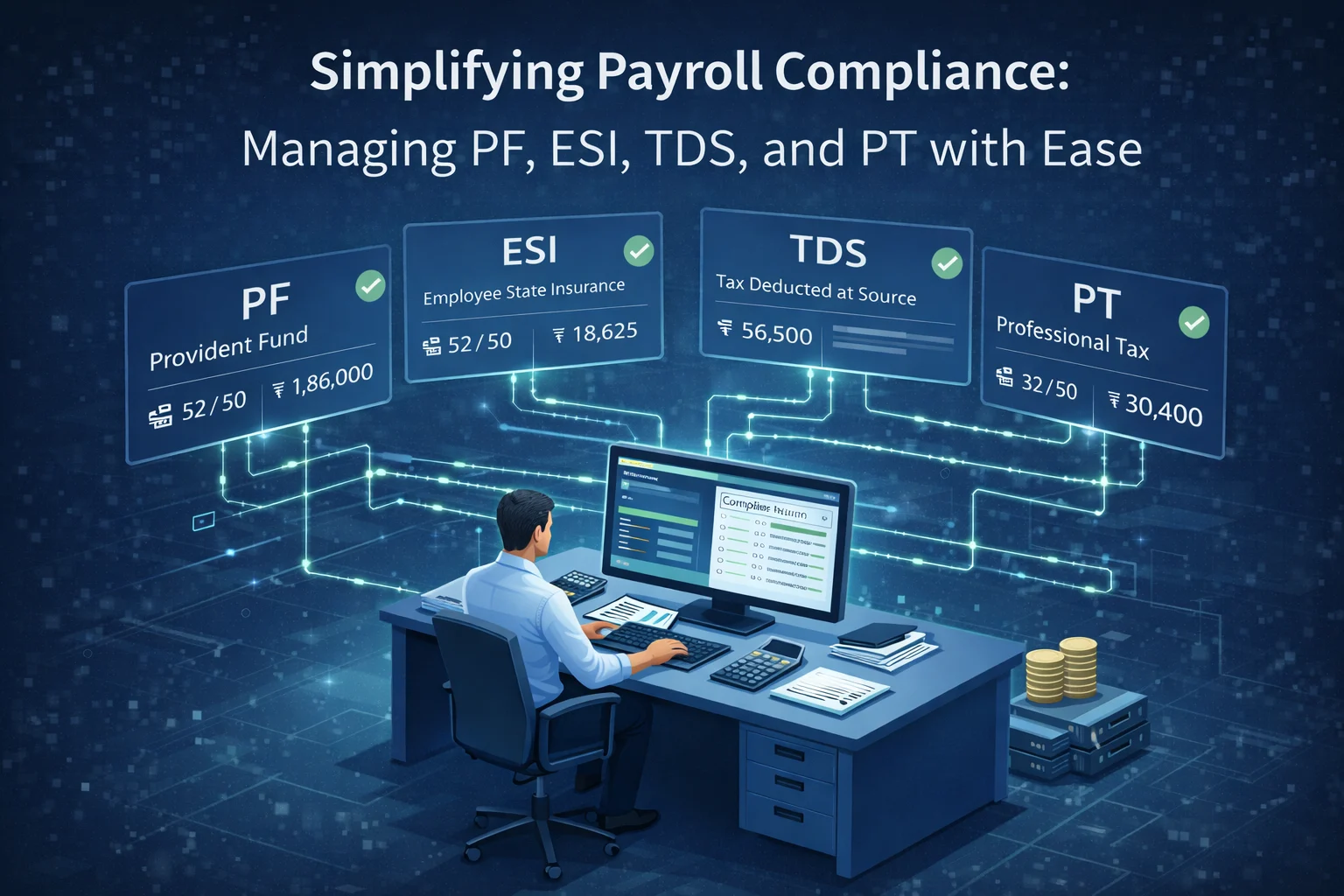
Simplifying Payroll Compliance: Managing PF, ESI, TDS, and PT with Ease
Payroll compliance in India Can feel like navigating a maze of regulations, Deadline and acronyms. To HR managers and business owners, The challenge is not only paying employees On timeframe- that's for sure. Every deduction, Contribution and submission of agreements statutory requirements. Miss a deadline or miscalculation a contribution, And you're looking at fines, audits and more. Unhappy employees. The good news? with the right understanding and systems In place, arrangement PF, ESI, TDS, and PT It doesn't have to be too much. Let's break down. Each component And explore. Practical strategies To remain non- compliant the stress.
Understanding the Four Pillars of Payroll Compliance
Provident Fund (PF): Building Employee Security
The Employees' Provident Fund is a retirement savings scheme managed by the EPFO. Both employer and employee contribute 12% of the basic salary plus dearness allowance each month. The employee's share goes entirely to their PF account, while the employer's contribution is split between the EPF (3.67%), Employees' Pension Scheme (8.33%), and administrative charges (1.1%).
Key compliance points:
- Applicable to organizations with 20 or more employees
- Monthly contributions must be deposited by the 15th of the following month
- UAN (Universal Account Number) must be generated for all eligible employees
- Annual returns through ECR (Electronic Challan-cum-Return) are mandatory
Missing PF deadlines attracts 12% annual interest on delayed payments, plus potential damage charges. The key is maintaining accurate employee data and ensuring timely salary processing.
Employee State Insurance (ESI): Healthcare Protection
ESI provides medical and cash benefits to employees earning up to ₹21,000 per month. The contribution rate is 3.25% from employers and 0.75% from employees, calculated on gross wages.
Key compliance points:
- Applicable to establishments with 10+ employees (varies by state)
- Contributions due by the 15th of the following month
- New joinees must be registered within 10 days
- IP (Insured Person) numbers must be issued promptly
ESI compliance requires coordinating with local ESI dispensaries and maintaining updated records of employee wages, including overtime and bonuses that affect gross salary calculations.
Tax Deducted at Source (TDS): Income Tax Management
TDS on salaries requires employers to deduct tax based on employee income slabs and deposit it with the government. This involves understanding exemptions, deductions under various sections, and investment declarations.
Key compliance points:
- Monthly TDS deduction based on projected annual income
- Deposit due dates: 7th of the following month (15th-30th for March)
- Quarterly TDS returns (Form 24Q) due by specific dates
- Annual Form 16 issuance to employees by June 15th
The challenge with TDS is accuracy. Employees claim deductions for house rent, home loans, insurance, and investments. Collect these declarations early in the financial year and reconcile them regularly to avoid year-end scrambles or excess deductions.
Professional Tax (PT): State-Level Levy
PT is a state-imposed tax on professions, trades, and employment. Rates and slabs vary by state—Maharashtra charges up to ₹2,500 annually, Karnataka up to ₹2,400, while states like Delhi don't levy PT at all.
Key compliance points:
- Deduct from employee salary based on applicable state slab
- Monthly deposit deadlines vary by state (typically by the 20th)
- Annual returns and renewal of PT registration certificates
- Different rates for different salary brackets
If you have employees across multiple states, you'll need to track different PT rates, deadlines, and filing requirements for each location.
Common Pitfalls and How to Avoid Them
Late deposits: Set up automated reminders at least a week before statutory deadlines. Consider maintaining a compliance calendar that flags PF (15th), ESI (15th), TDS (7th), and PT (varies) deadlines monthly.
Incorrect calculations: Manual calculations are error-prone. A single mistake in basic salary calculation cascades into wrong PF, ESI, and TDS amounts. Invest in payroll software that automatically computes statutory deductions based on latest rules.
Missing employee declarations: Employees often submit investment proofs or Form 12BB late, leading to TDS mismatches. Establish a clear policy with cutoff dates and communicate consequences of delays.
Reconciliation gaps: Monthly reconciliation between payroll registers and challan deposits prevents year-end surprises. Maintain separate ledgers for each statutory head and conduct quarterly audits.
Registration lapses: New joiners must be registered with PF and ESI within stipulated timeframes. Delays create compliance gaps and employee grievances. Automate registration workflows whenever possible.
Leveraging Technology for Seamless Compliance
Modern payroll software has changed compliance management. Integrates directly with leading platforms. Government portals, to activate one- click challan generation, Automatic return filing, and real- time compliance dashboards. Analyze for solutions that offer automation. Statutory calculations, Onboarding with a large amount of employees automatic PF/ ESI registration, Integration with EPFO/ ESIC/ Income Tax portals, Preserve track of compliance notices and deadlines, and detailed audit trails to every transaction. Cloud- based systems ensure your payroll data Accessible, yet secure, with role- based access control and regular backups. Many platforms now include AI- powered. Error detection which flags irregularities before treatment.
Building a Compliance-First Culture
Technology alone isn't enough. Create a culture where compliance is everyone's responsibility. Train your HR team regularly on regulatory updates—labor laws change frequently, and ignorance isn't a defense. Establish clear SOPs for salary processing, statutory filing, employee onboarding, and document management.
Communicate with employees about their statutory benefits. When employees understand what PF and ESI mean for them, they're more likely to provide accurate information and update changes promptly.
Conduct periodic internal audits even if you're using software. A quarterly review of your compliance status helps catch issues before they become problems during official audits.
The Bottom Line
Payroll compliance is not optional, and the penalties for non- compliance can be severe– both financially and reputationally. But it doesn't have to be. A monthly source of anxiety. With systematic processes, The right technology, and proactive management, You can change the match. A burden In an organized operation. Commence with revision. Your current process. Where is the bottlenecks? Which tasks are manual that can be automated? What deadlines do you constantly struggle with? the address these gaps Systematic, and you will locate that compliance becomes justice. Another routine part of running Your business- not the nightmare it often seems. Remember, compliant payroll It's not just about avoiding fines. It's approx building trust with your employees, to maintain your company's reputation, And creation a foundation to sustainable growth. When your team acknowledge their statutory benefits Handled correctly and on duration, they can focus on what is most important– driving your business forward.