




ATCHAYA M
Updated on
30-07-2026
What Happens If e-Invoices Are Not Generated on Time?
Businesses that are subject to the e-Invoicing requirements of GST are required to register their invoices with the Invoice Registration Portal (IRP) prior to issuing them to their customers. The timing of generating the e-Invoice is critical; late generation of the e-Invoice may have serious consequences, including compliance issues, operational delays, and difficulties in tax reporting.
Businesses frequently do not appreciate the critical nature of timely generation of e-Invoices, thinking that they can generate the IRN later or change their records later; however, the Registration Process of e-Invoices is required by the GST Framework, which means that any delay in generating the document can create downstream complications.
The Invoices Are Considered Invalid
Properly issued invoices are essential for customers to claim their Input Tax Credits (ITCs). If a supplier fails to generate their e-invoices correctly and on time, the customer may face difficulty in claiming their ITCs. In such circumstances, both vendors and customers may experience operational friction.
As a result, customers may have to request corrected invoices, frequently follow-up, or hold off on filing their compliance reports until the issue has been resolved.
Customers May Face Input Tax Credit Issues
Customers depend on properly issued invoices to claim Input Tax Credit (ITC). If the supplier fails to generate the e-Invoice correctly or on time, the customer may not be able to claim ITC smoothly.
This situation can create operational friction between vendors and customers. Customers may need to request corrected invoices, follow up repeatedly, or delay their own compliance reporting until the issue is resolved.
Over time, repeated invoicing delays can affect vendor credibility and customer trust.
Disruption in Goods Movement
For businesses dealing with goods, delayed e-Invoicing can also affect logistics operations. Since e-Invoice data is often linked with e-Waybill generation, any delay in generating the IRN may slow down the movement of goods.
Transport documentation, dispatch processes, and delivery schedules may be impacted if the required invoice details are not properly registered in time.
This can cause operational bottlenecks, particularly for businesses with high transaction volumes or tight delivery timelines.
GST Return Reporting Mismatches
Late or missing e-Invoices can also create discrepancies in GST return reporting. Businesses must ensure that all eligible invoices are accurately reported in their GST returns.
If e-Invoices are generated late or incorrectly, it can result in mismatches between:
- Invoice records
- e-Invoice data
- GST return filings
These mismatches may require additional reconciliation efforts and could potentially trigger compliance queries.
Increased Administrative Work
Correcting invoicing mistakes after the fact often requires additional documentation such as credit notes, revised invoices, or amended records. These corrections increase administrative workload for finance teams.
Instead of focusing on normal accounting and compliance tasks, teams may need to spend extra time identifying errors, correcting records, and communicating with customers.
Maintaining timely invoicing practices helps avoid such unnecessary effort.
Risk of Compliance Scrutiny
GST authorities expect businesses to follow invoicing rules carefully, especially when e-Invoicing is applicable. Consistent delays or irregularities in invoice generation may attract attention during compliance checks.
Businesses that maintain accurate and timely invoicing records are generally better prepared to handle audits or regulatory reviews.
Operational Impact on Business Processes
Beyond compliance, invoicing delays can affect internal business processes. Sales teams, finance departments, and logistics operations often rely on invoice data for their daily activities.
When invoices are not generated on time, it may affect payment cycles, reporting accuracy, and financial planning. Timely invoicing ensures that business operations remain smooth and predictable.
Conclusion
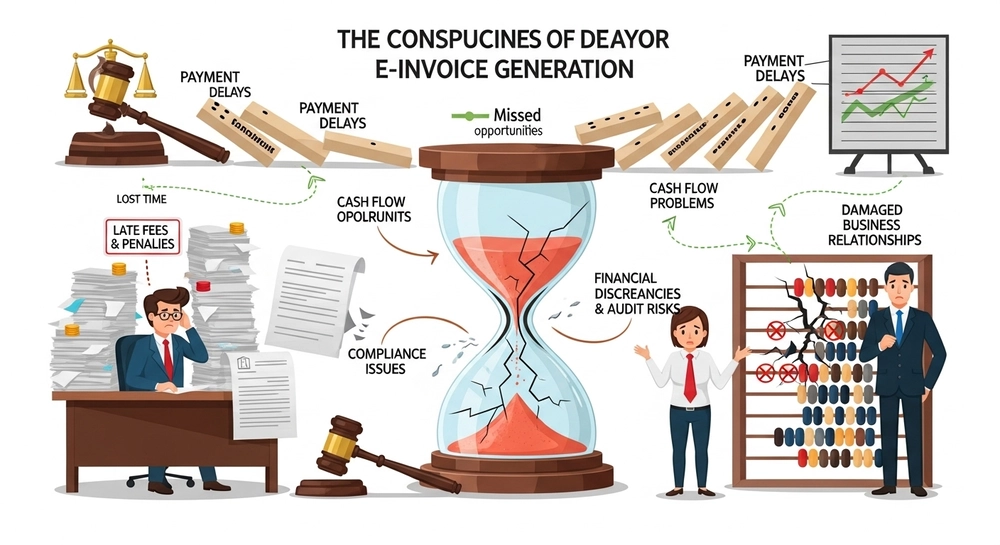
Timely generation of e-Invoices is an essential part of GST compliance for eligible businesses. Delays in registering invoices on the IRP can lead to invalid documentation, customer ITC issues, logistics disruptions, and additional reconciliation work.
By ensuring that invoices are generated and registered promptly, businesses can maintain compliance accuracy, support their customers’ tax reporting, and keep their operational workflows running smoothly. A disciplined approach to e-Invoicing ultimately strengthens both compliance reliability and business relationships.