




PUGALENTHI
Updated on
30-07-2026
When Should You Register for GST? A Complete Guide
In India, the Goods and Services Tax (GST) is a vital component of the modern tax structure aimed at streamlining the indirect tax system. Understanding when you should register for GST is crucial, not just for compliance but also for the potential benefits it can bring to your business. This article will decode GST registration, the conditions under which it is required, and how it can foster your business growth.
Understanding GST Registration and Its Importance
GST registration is mandatory for businesses meeting specific criteria. It enables a business to collect tax from its customers legally and claim input tax credit (ITC) on taxes already paid on purchases. Registering for GST signifies that the business is recognized for tax purposes, which enhances its credibility and fosters business growth by ensuring compliance with legal norms.
Aggregate Turnover and Threshold Limits for GST Registration
The need to register for GST often hinges on a term known as "aggregate turnover." This refers to the total value of all taxable supplies, exempt supplies, exports of goods or services, and inter-state supplies a business makes. Here's a quick rundown of threshold limits:
- For goods: If your aggregate turnover exceeds Rs.40 lakh in most states and Rs.20 lakh in special category states.
- For services: If your aggregate turnover exceeds Rs.20 lakh in most states and Rs.10 lakh in special category states.
Mandatory GST Registration Scenarios
Certain conditions mandate GST registration even if your aggregate turnover is below the prescribed limit. These include:
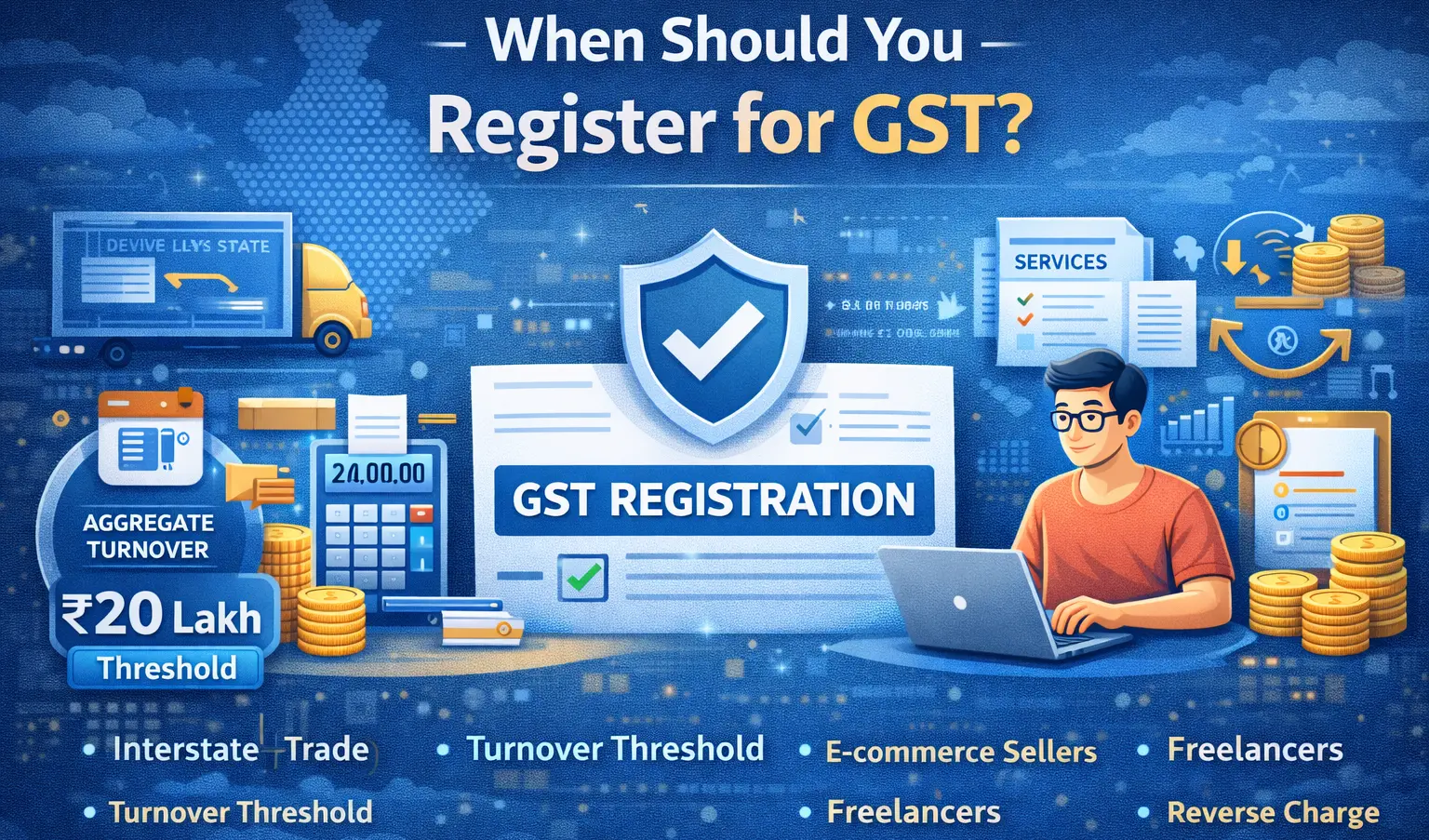
- Interstate Supply of Goods or Services: If your business supplies goods/services across state lines, GST registration is mandatory.
- E-commerce Operators and Sellers: Businesses selling via online platforms must register regardless of turnover.
- Reverse Charge Mechanism: If you’re a business subject to GST under the reverse charge mechanism, registration is non-negotiable.
- Special GST Provisions: Certain businesses, such as casual taxable persons or non-resident taxable persons, need to register irrespective of turnover.
Practical Examples for Understanding Real-world Applicability
To make things clearer, let’s consider some common business scenarios:
- Small Business: A bakery shop with sales exceeding the threshold must register for GST to legally collect tax from customers.
- Freelancers: A freelance graphic designer working with interstate clients should register to avail ITC and expand business.
- Startups: A tech startup offering SaaS products across state borders must obtain GST registration for seamless operations.
- Service Providers: Event organizers hosting events across states are required to register regardless of their turnover.
Benefits of Voluntary GST Registration
Even if you do not meet the mandatory criteria, opting for voluntary GST registration offers advantages:
- Input Tax Credit (ITC): Claim ITC on your purchases, reducing overall tax liability.
- Business Credibility: Being a GST-registered entity enhances your brand image and credibility.
- Expanded Market Reach: Access larger markets, as many companies prefer dealing with GST-compliant suppliers.
Consequences of Late or Non-registration
Failing to register for GST when required can result in severe penalties and compliance risks:
- Penalties: Absence of registration can attract a penalty of 10% of the tax due or Rs.10,000, whichever is higher.
- ITC Denial: You cannot claim ITC without GST registration, potentially increasing your costs.
- Legal Consequences: Non-registration may lead to legal action impacting your business operations.
Common Misconceptions and Mistakes
Let's clear up some common misconceptions related to GST registration:
- Freelancers Exemption: Freelancers often incorrectly assume GST doesn’t apply to them.
- Exports Requiring No Registration: Businesses exporting goods/services need GST registration for claiming refunds.
A Checklist for GST Registration
Use this checklist to decide if your business requires GST registration:
- Is your aggregate turnover above the threshold?
- Do you supply goods/services interstate?
- Did you commence selling through e-commerce?
- Does your business deal with reverse charge mechanism?
- Are you a casual taxable person?
If any answers are "yes," consider proceeding with GST registration. Moreover, using GST software or consulting with experts can streamline the registration and compliance process.
Conclusion
Starting a business requires good planning. However, one important step that can help with your company's success is to register for GST. Registering for GST provides various benefits and opportunities for new businesses. By recognizing why and when to register, your business will ultimately make informed decisions that avoid penalties and utilize the advantages of being registered. You must also keep abreast of current developments regarding GST to comply with regulations and maintain a smooth running company.
Hopefully, this guide has provided you with enough information to register for GST, establish confidence in your leadership skills as an entrepreneur, and promote growth in your business all while meeting legal requirements.
LEDGERS
LEDGERS assists with compliance relating to GST through the integration of reconciliations into your accounting processes to allow the speedy identification of errors in records prior to incurring any penalties or interest. LEDGERS allows you to automate the process of synchronizing your GSTN data and tracking invoices on an invoice-by-invoice basis eliminating the need for manual corrections and the time-consuming process of verifying transactions at the end of a reporting period through the use of automatic validations from the system to facilitate revenue compliance activities.