




PUGALENTHI
Updated on
30-07-2026
GST Ledger Explained: Electronic Cash, Credit & Liability Ledger
The Goods and Services Tax (GST) in India has simplified the complex and disparate indirect tax system since it has been introduced. Compliance with tax legislation has become less complex for businesses to comply with. Businesses must understand the entire GST Ledger system in order to track the amount they will owe for their GST, any Input Tax Credit (ITC) they receive, and their overall tax liability. This article discusses how these ledgers function within the GST Ledger system by providing a brief overview of the Electronic Cash Ledger, Electronic Credit Ledger, and Electronic Liability Ledger of GST. In order for businesses to properly comply with the GST and effectively manage their financials, they need to understand how these ledgers function.
Understanding GST Payments and the Role of Ledgers
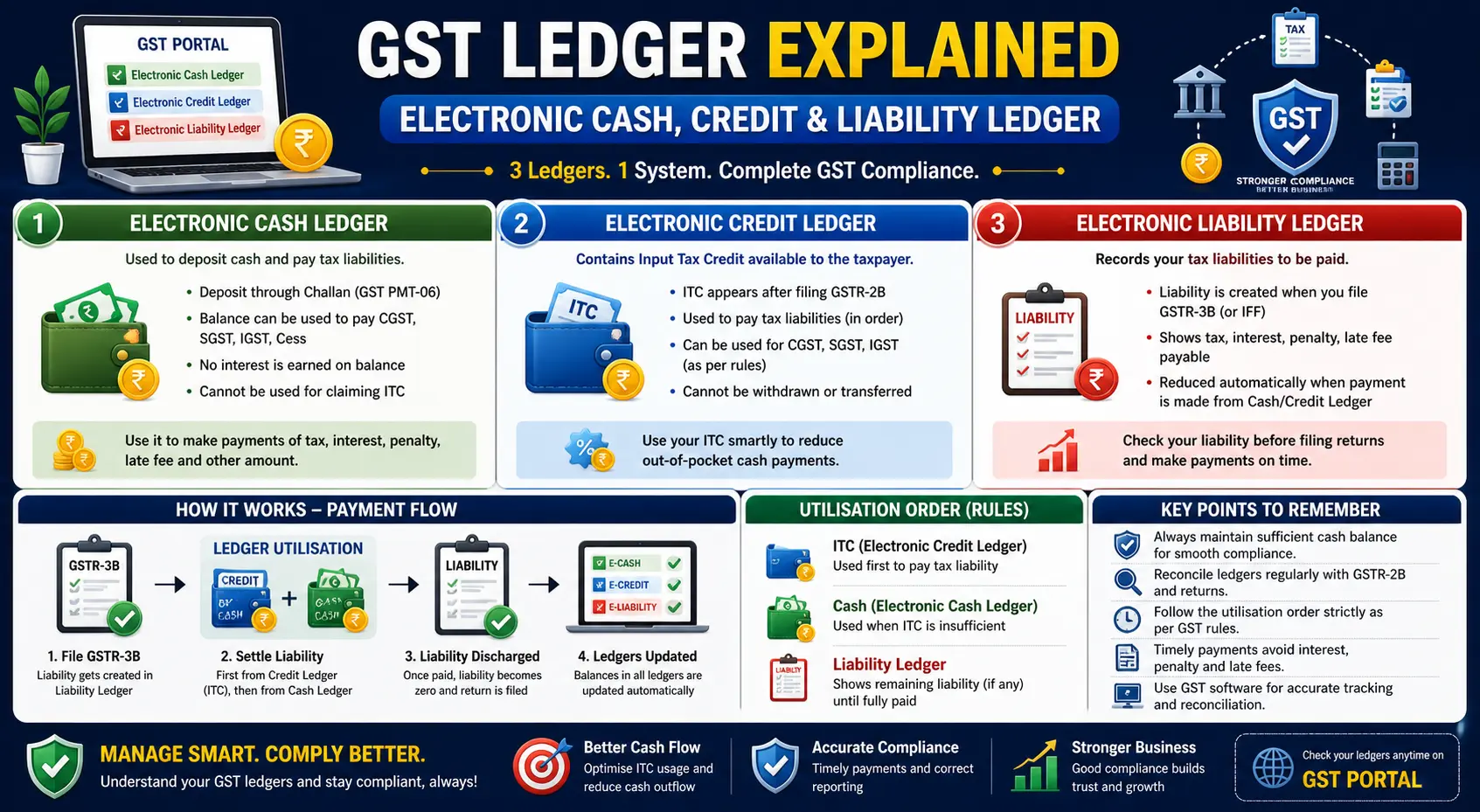
When businesses pay their taxes under the GST framework, they utilize three main ledgers to maintain their accounts. These ledgers are integral components of the GST portal, providing an organized way for taxpayers to track their tax payment status and ensure compliance with regulatory requirements. Let us explore each of these ledgers and their functions.
Electronic Cash Ledger: Overview and Functions
The Electronic Cash Ledger is akin to an online wallet taxpayers use to deposit money for GST payments. Here’s how it works:
- Used to deposit cash for paying GST, interest, penalties, fees, and other dues.
- Each transaction generates a unique identification number, ensuring traceability.
- Transparent tracking of deposits and payments to avoid discrepancies.
For example, if a business anticipates paying ₹10,000 for its next GST filing, it can deposit this amount into the Electronic Cash Ledger. When the filing date arrives, the business uses the ledger funds to pay the due amount, guaranteeing that the necessary money is readily available.
Electronic Credit Ledger: Unpacking Input Tax Credit
The Electronic Credit Ledger is where taxpayers record their Input Tax Credits (ITC). Here's its importance:
- Records the ITC available to a taxpayer.
- Utilized to pay off tax liabilities on the output supplies.
- Restricted to the non-cash settlement of liabilities.
Suppose a business purchases raw materials worth ₹50,000 and pays an 18% GST, amounting to ₹9,000. This ₹9,000 is recorded in the Electronic Credit Ledger and can offset the GST liability on finished goods. It's an efficient way to reduce tax outflow by taking credits for the tax already paid on inputs.
Electronic Liability Ledger: Tracking Tax Dues
The Electronic Liability Ledger is a comprehensive record of all outstanding tax liabilities.
- Automatically maintained by the GST system.
- Reflects all payable liabilities, including tax, interest, penalty, etc.
- Updated when returns are filed or payments made.
For instance, when a taxpayer files monthly returns, any due tax amounts are updated in the ledger. This ledger is pivotal in monitoring dues and minimizing the risks of non-compliance.
Interconnection of Ledgers During GST Return Filing
During the GST return filing process, these ledgers interact seamlessly:
- The taxpayer files returns, which updates the Electronic Liability Ledger with any tax liabilities.
- The Electronic Credit and Cash Ledgers are then utilized to offset these liabilities.
- The correct order of ITC utilization must be followed, as prescribed by GST laws.
Following these steps ensures accurate reconciliation of accounts and simplifies the return filing process.
Examples of Tax Payment and ITC Utilization
To further clarify the process, consider a scenario where a taxpayer has the following balances:
- Electronic Cash Ledger: ₹5,000
- Electronic Credit Ledger: ₹8,000 (CGST) and ₹4,000 (SGST)
- Electronic Liability Ledger: ₹10,000 (CGST) and ₹5,000 (SGST)
In this case:
- Use ₹8,000 of CGST ITC to pay the CGST liability.
- Pay the remaining ₹2,000 CGST liability using the Cash Ledger.
- Offset the SGST liability using the ₹4,000 SGST ITC and the remaining ₹1,000 from the Cash Ledger.
Common Mistakes and Best Practices
Many businesses frequently stumble on GST ledger management due to:
- Ignoring ledger reconciliations, leading to discrepancies.
- Incorrect utilization order of ITC, causing compliance issues.
- Failure to keep ledgers updated regularly.
Best Practices for Managing GST Ledgers
Efficiently managing your GST ledger involves adopting certain practices:
- Regular reconciliation of ledger balances to identify discrepancies.
- Adhering strictly to ITC utilization rules to avoid penalties.
- Utilizing GST software for automated entry management and error reduction.
Conclusion
Maintaining accurate GST ledgers is indispensable for effective tax management and compliance. By understanding how each ledger functions and interacts, businesses can streamline their GST processes, avoid common pitfalls, and leverage effective financial management strategies. Diligently managing these ledgers—through automation tools and adherence to best practices—ensures a smooth GST compliance journey, setting the foundation for robust financial health.
LEDGERS assists with compliance relating to GST through the integration of reconciliations into your accounting processes to allow the speedy identification of errors in records prior to incurring any penalties or interest. LEDGERS allows you to automate the process of synchronizing your GSTN data and tracking invoices on an invoice-by-invoice basis eliminating the need for manual corrections and the time-consuming process of verifying transactions at the end of a reporting period through the use of automatic validations from the system to facilitate revenue compliance activities.