




PUGALENTHI
Updated on
30-07-2026
Best Practices for GST Data Validation Before Filing
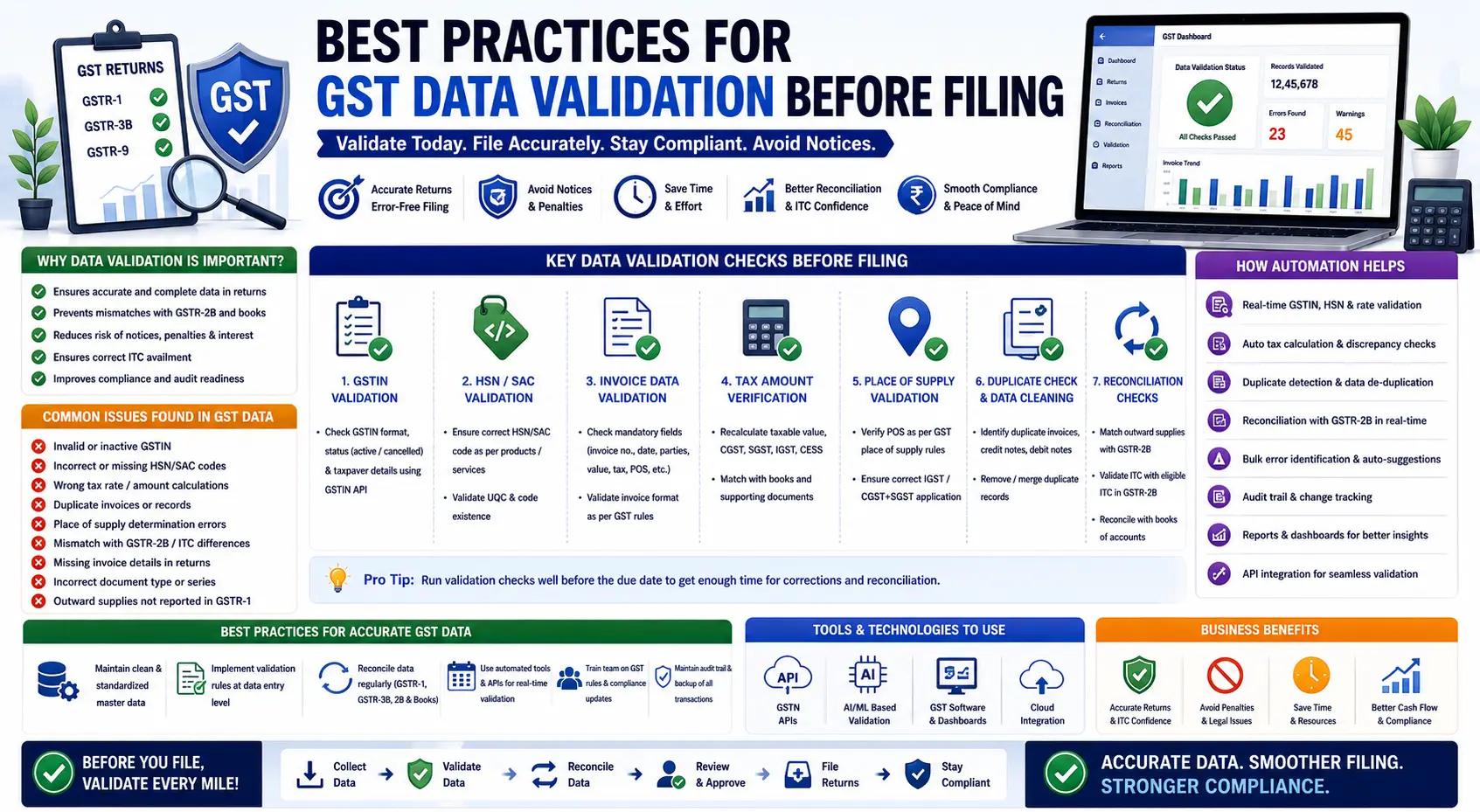
In the realm of Goods and Services Tax (GST) compliance, accurate data validation is a cornerstone of smooth and penalty-free returns filing. Mistakes in GST returns, stemming from incorrect invoice data, mismatched returns, invalid GSTINs, wrong tax calculations, and duplicate records, can lead to hefty penalties, notices, and reconciliation issues. This article delves into why GST data validation is essential before filing your GSTR-1, GSTR-3B, and annual returns, and how businesses can safeguard themselves against common pitfalls through best practices and automation.
Introduction to Common GST Filing Errors
When filing GST returns, businesses often confront various issues that can disrupt their compliance processes:
- Incorrect Invoice Data: Misprints or errors in invoices can distort the filing process.
- Mismatched Returns: Discrepancies between GSTR-1 and GSTR-3B returns can trigger notices.
- Invalid GSTINs: Invalid or expired GSTINs complicate verification steps.
- Wrong Tax Calculations: Missteps in tax calculations lead to financial discrepancies.
- Duplicate Records: Entering duplicate invoices creates data reconciliation problems.
Why Validation is Critical for GST Returns
Accurate validation acts as a preventive measure against compliance breaches. Proper validation before filing GSTR-1 and GSTR-3B ensures:
- Alignment with real-time data in GSTR-2B, reducing mismatch issues.
- Prevention of subsequent errors in annual returns.
- Minimized chances of government-issued notices and penalties.
Key Validation Areas
To maintain compliance and streamline the filing process, businesses should focus on key validation areas:
- GSTIN Verification: Verify all GSTINs for validity.
- HSN/SAC Code Validation: Ensure appropriate HSN/SAC codes for all goods and services.
- Invoice Format Checks: Confirm correct invoice formats to ensure legality.
- Tax Amount Verification: Double-check tax calculations for accuracy.
- Place of Supply Validation: Validate the place of supply for tax applicability.
- Duplicate Invoice Detection: Identify and remove any duplicate entries.
- Reconciliation with GSTR-2B and Books of Accounts: Reconcile your data with GSTR-2B and ensure consistency with your books of accounts.
Practical Examples of Common Mistakes
Consider a scenario where a business enters a wrong GSTIN while preparing invoices. This error can lead to notices from tax authorities due to mismatch with their records. Similarly, incorrect HSN codes can lead to miscalculated tax liability, resulting in under or overpayment of taxes.
Identifying and Correcting Mistakes
Businesses can leverage GST software tools to quickly identify and rectify errors before final submissions. Through automated validation processes, businesses can:
- Highlight discrepancies between reported and recorded data.
- Ensure GSTIN accuracy through real-time API verification tools.
- Simplify reconciliation with intuitive dashboards and reports.
Role of Automation and GST Software
With technological advancements, automation and GST software have emerged as vital in reducing manual effort and enhancing accuracy. The role of such tools includes:
- Performing real-time validations that check for data discrepancies.
- Utilizing APIs to update and verify GSTINs promptly.
- Alleviating the burden on human resources through automated process flows.
Best Practices for GST Data Validation
- Maintain Standardized Master Data: Ensure consistency and reduce errors through uniform data management.
- Implement Validation Rules: Regularly update and apply new validation rules to meet compliance standards.
- Regular Reconciliation: Schedule periodic reconciliations with GSTR-2B to prevent discrepancies.
- Audit Trail Tracking: Keep comprehensive records of all transactions for accountability and accuracy.
Compliance and Financial Benefits
Accurate GST data validation offers significant compliance and financial benefits:
- Reduced likelihood of notices and penalties from tax authorities.
- Smoother processing of GST returns with minimized reconciliation errors.
- Enhanced financial planning and resource allocation due to accurate tax assessments.
Conclusion
Ensuring accurate GST data validation before filing is not just a regulatory obligation but a financial imperative. By adopting best practices such as leveraging automation, performing regular reconciliations, and maintaining standardized master data, businesses can prevent compliance issues and enhance operational efficiency. Investing in automated GST validation tools may prove indispensable for efficient compliance management in today’s fast-paced business environment.
In conclusion, by prioritizing data accuracy and integrating advanced validation methods, businesses can elevate their GST compliance, avert penalties, and ensure smoother return processes.
LEDGERS assists with compliance relating to GST through the integration of reconciliations into your accounting processes to allow the speedy identification of errors in records prior to incurring any penalties or interest. LEDGERS allows you to automate the process of synchronizing your GSTN data and tracking invoices on an invoice-by-invoice basis eliminating the need for manual corrections and the time-consuming process of verifying transactions at the end of a reporting period through the use of automatic validations from the system to facilitate revenue compliance activities.