




PUGALENTHI
Updated on
30-07-2026
Understanding GST for SaaS Companies in India: A Comprehensive Guide
In the dynamic world of Software-as-a-Service (SaaS), businesses deliver cloud-based software solutions to clients globally. As this business model rapidly evolved, so did the need to understand the Goods and Services Tax (GST) implications for SaaS companies operating in India. This article serves as a comprehensive guide to navigating GST applicability, compliance requirements, and the unique taxation challenges faced by SaaS companies in India.
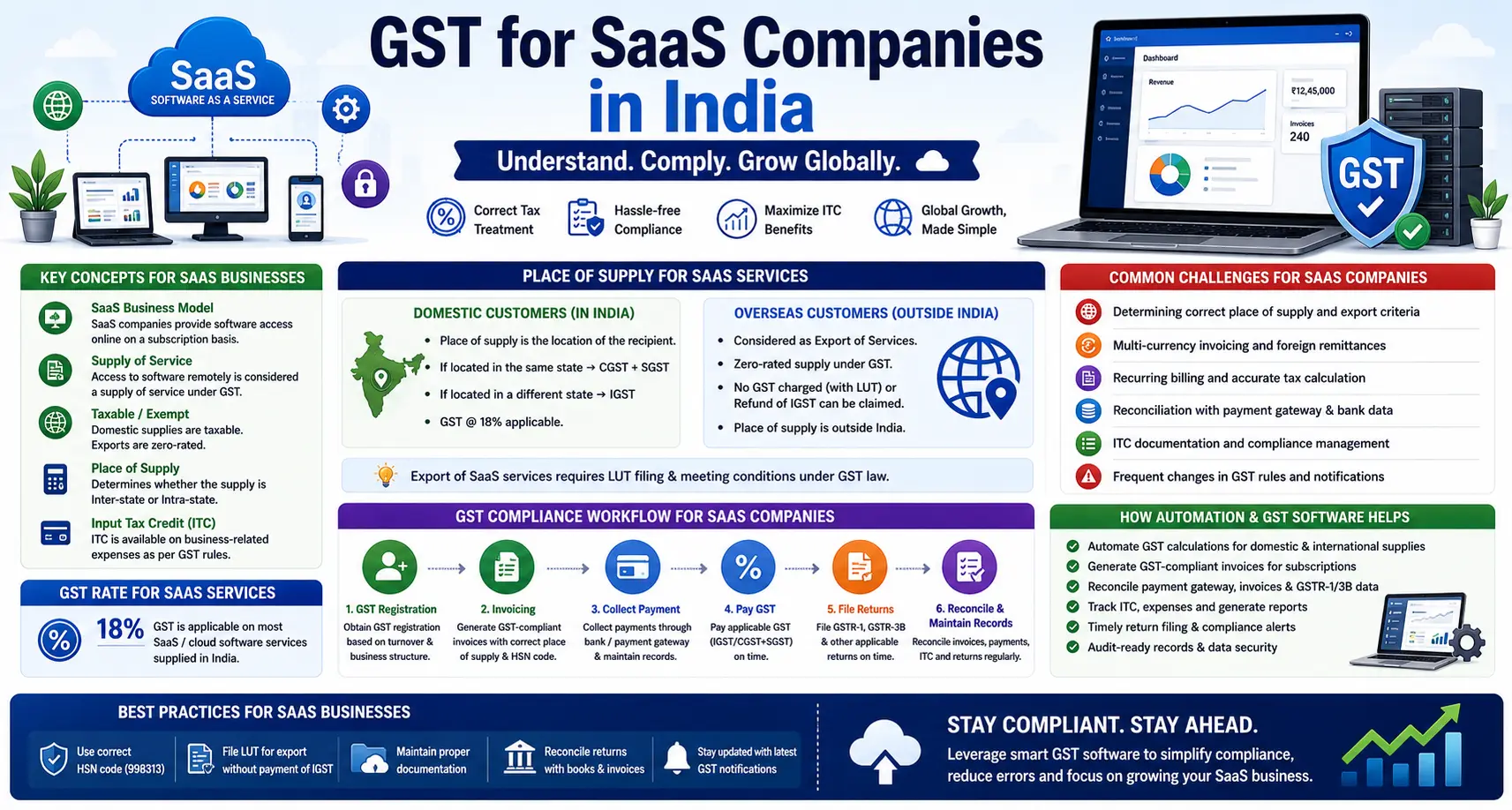
The SaaS Business Model and GST Applicability
The SaaS model is emblematic of the shift towards digital and cloud-based service delivery, offering software access over the internet rather than through traditional licensing. This ease of dissemination comes with its own set of tax complexities, particularly concerning GST.
GST applies to SaaS companies in India as they fall under the ambit of "Online Information and Database Access or Retrieval (OIDAR) services." This categorization means SaaS services are subject to GST, similar to tangible goods and conventional services. Here’s how:
- GST is levied on SaaS subscriptions and service fees billed to Indian customers.
- Place of supply rules determine GST applicability: For B2B transactions, it is the location of the registered business recipient; for B2C, it is the service provider's location.
- Export of services can benefit from zero-rated treatment under GST, provided certain conditions are met.
Key GST Concepts for SaaS Companies
Understanding specific GST concepts is crucial for SaaS companies to ensure compliance and optimize tax liability:
Place of Supply
The place of supply is pivotal in determining GST applicability on SaaS services. In India, for B2B transactions, the place of supply is typically the location of the service recipient. However, for B2C services, the place tends to default to the service provider’s location. This distinction is essential for determining whether SGST, CGST, or IGST applies.
Export of Services
SaaS services provided to international clients can classify as exports, given the supply adheres to the criteria laid out under GST laws. Such services can avail zero-rated GST, provided the SaaS company files a Letter of Undertaking (LUT) or pays IGST, subsequently claiming a refund. This zero-rated treatment is particularly advantageous for maintaining cash flow and competitiveness in global markets.
GST Rates and Invoicing
The standard GST rate applicable to SaaS services in India is 18%. SaaS companies must structure their invoicing to comply with GST rules, incorporating necessary elements like GSTIN, the HSN code for services, tax amounts, and place of supply. Precision in invoicing is crucial to preempt discrepancies that could attract penalties.
Input Tax Credit (ITC) Eligibility
SaaS companies can claim ITC on the GST paid for business-related expenses. This includes any input services that help deliver SaaS offerings. Proper documentation and adherence to GST return filing timelines are critical in availing ITC efficiently.
Domestic vs. International Clients: GST Differences
For domestic clients, GST is straightforward: the SaaS company charges GST per applicable rates. For international clients, zero-rated GST or IGST applies if the supply conditions meet export criteria. LUT filing becomes a necessity for exporting without burdening clients with GST.
Real-World Examples for Better Understanding
B2B SaaS Platforms
A B2B SaaS provider offering project management solutions to Indian businesses applies IGST if the place of supply is different between states, ensuring seamless credit transfer to their clients.
Subscription Billing Platforms
For platforms handling recurring subscriptions, automated GST compliance solutions facilitate accurate billing and GST computation, despite client diversity.
Global SaaS Providers
International SaaS providers offering services to Indian users need a simplified GST registration process to ensure compliance without altering their global pricing strategies.
Compliance Challenges for SaaS Companies
SaaS businesses face unique challenges concerning GST compliance:
- Multi-currency invoicing requires precise conversion and documentation for accurate GST reporting.
- Recurring billing necessitates automation to manage constant adjustments and consistent GST calculation.
- Foreign remittances and reconciliation of data from various online payment gateways demand vigilant oversight.
Automating GST Compliance: A Necessity for Growth
Automation in GST compliance through specialized software can significantly enhance efficiency for SaaS companies. Essential features include:
- Automated invoicing and GST calculations aligned with legal amendments.
- Facilitated reconciliation of payment gateways with GST return filings.
- Efficient digital record maintenance ensures compliance readiness for audits.
Best Practices for GST Compliance
To maintain compliance and manage GST complexities, SaaS companies should:
- Implement automated solutions to simplify tax computation and return filing.
- Maintain meticulous digital records of all transactions and GST filings.
- Stay updated on GST regulatory changes affecting OIDAR service classifications.
- Train staff on GST-related processes and the operational use of GST compliance tools.
Conclusion
As SaaS companies continue to navigate the expanding digital landscape in India, understanding GST applicability is crucial for sustaining and growing operations. By embracing automation and adhering to best practices, businesses can enhance compliance, streamline processes, and stay audit-ready. Keeping abreast of GST developments will not only ensure legal adherence but also position SaaS providers for sustained success in a competitive market.
This guide aims to equip SaaS companies with the knowledge and tools necessary to overcome GST challenges, highlighting the importance of compliance in bolstering business credibility and growth.
LEDGERS assists with compliance relating to GST through the integration of reconciliations into your accounting processes to allow the speedy identification of errors in records prior to incurring any penalties or interest. LEDGERS allows you to automate the process of synchronizing your GSTN data and tracking invoices on an invoice-by-invoice basis eliminating the need for manual corrections and the time-consuming process of verifying transactions at the end of a reporting period through the use of automatic validations from the system to facilitate revenue compliance activities.