




PUGALENTHI
Updated on
30-07-2026
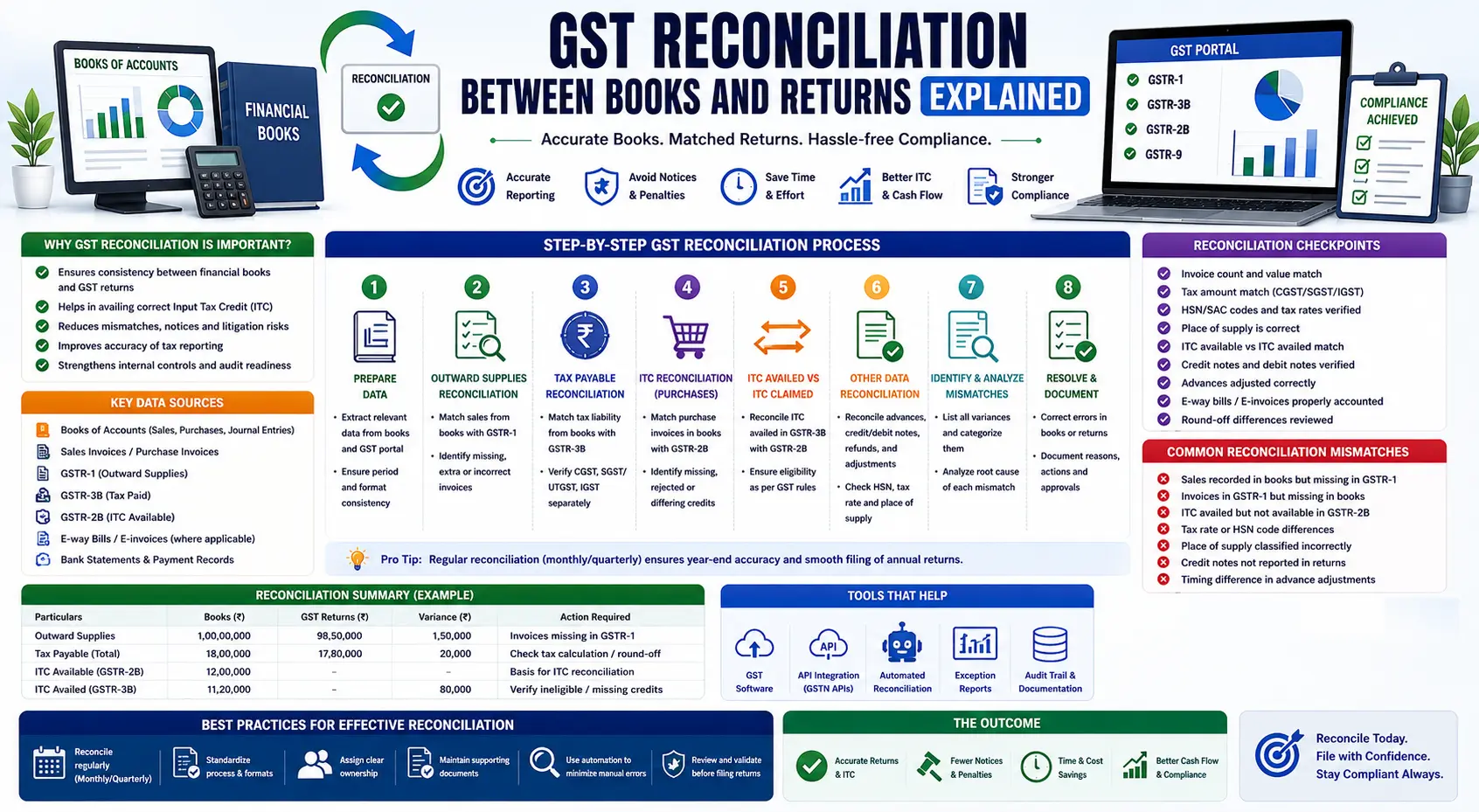
In the complex world of Goods and Services Tax (GST) compliance in India, businesses often face the daunting task of reconciling their accounting records with GST returns. "GST Reconciliation Between Books and Returns Explained" aims to demystify this process and emphasize the critical importance of maintaining accurate compliance by aligning your financial books with GST returns.
GST Reconciliation Between Books and Returns Explained
GST reconciliation refers to the process of matching your business’s financial records with the GST returns filed. This involves aligning invoices, tax payments, and credit claims noted in your books of accounts with the details provided in your GST returns. Ensuring that this reconciliation is accurate is essential in avoiding compliance risks, minimizing potential penalties, and securing the rightful claims of Input Tax Credit (ITC).
The Dangers of Mismatches
Mismatches between your books of accounts and GST returns can have grave consequences, including:
- Receiving notices and inquiries from tax authorities.
- Incurred penalties due to discrepancies.
- Loss of ITC, impacting cash flow.
- Increased compliance risks and potential legal complications.
Types of Reconciliation
To keep your GST records synchronized, several types of reconciliation need to be conducted, such as:
- Books and GSTR-1: Reconciliation for outward supplies.
- Books and GSTR-3B: Overall tax liabilities and claims report.
- Books and GSTR-2B: ITC claims reconciliation.
- Purchase and Sales Registers: Aligning records with corresponding registers.
- E-invoice Data: Matching invoices with recorded transactions.
Causes of Mismatches
Understanding common causes for mismatches can prevent future discrepancies:
- Missing invoices in either records or returns.
- Incorrect GSTIN entries leading to misallocations.
- Duplicate entries causing overstatement in records.
- Timing differences between transactions and reporting.
- Tax calculation errors due to rate misapplication.
- Supplier non-compliance affecting your ITC claims.
Practical Reconciliation Scenarios
For clarity, consider the following scenarios:
Outward Supplies
If a sales invoice is omitted from GSTR-1 but exists in financial records, it can result in an inaccurate tax liability, leading to a higher tax payment in GSTR-3B.
Inward Supplies
Missed purchase invoices not reflected in GSTR-2B can reduce eligible ITC claims, increasing tax costs.
Input Tax Credit (ITC)
Correct ITC calculations rely on accurate data from GSTR-2B. Supplier non-compliance might prevent ITC benefits if related invoices aren't uploaded.
Role of Reconciliation in Compliance
Effective reconciliation is crucial to:
- Ensure exact tax liabilities are reported and paid.
- Maximize eligible ITC claims, optimizing cash flow.
- Maintain precise financial reporting and statutory compliance.
Leveraging Automation Tools
With technology, reconciliation has become much more manageable:
- Automation tools detect mismatches and generate reconciliation reports in real-time.
- APIs and GST software streamline data integration, enhancing accuracy.
- Real-time analytics offer insights and improve decision-making processes.
Best Practices for Efficient Reconciliation
Adopting these best practices can significantly improve reconciliation efficiency:
- Conduct regular monthly reconciliation to prevent backlog issues.
- Maintain clean master data, ensuring accuracy in records.
- Implement thorough invoice validation before recording and reporting.
- Utilize audit trail tracking for better record accountability.
Conclusion
Maintaining compliance in the GST regime is both a critical and complex task for businesses in India. By understanding and addressing potential mismatches between accounting records and GST returns, you can significantly reduce compliance risks. Automation tools provide an invaluable resource for streamlining the reconciliation process, ensuring that your business remains compliant while maximizing ITC benefits. Regular reconciliation, accompanied by meticulous record-keeping and the appropriate usage of technology, stands vital in managing an efficient and effective GST compliance framework. Engaging with robust reconciliation solutions allows for better compliance management, shielding your business from the potential pitfalls of inaccuracies and inconsistencies.
LEDGERS assists with compliance relating to GST through the integration of reconciliations into your accounting processes to allow the speedy identification of errors in records prior to incurring any penalties or interest. LEDGERS allows you to automate the process of synchronizing your GSTN data and tracking invoices on an invoice-by-invoice basis eliminating the need for manual corrections and the time-consuming process of verifying transactions at the end of a reporting period through the use of automatic validations from the system to facilitate revenue compliance activities.