




PUGALENTHI
Updated on
30-07-2026
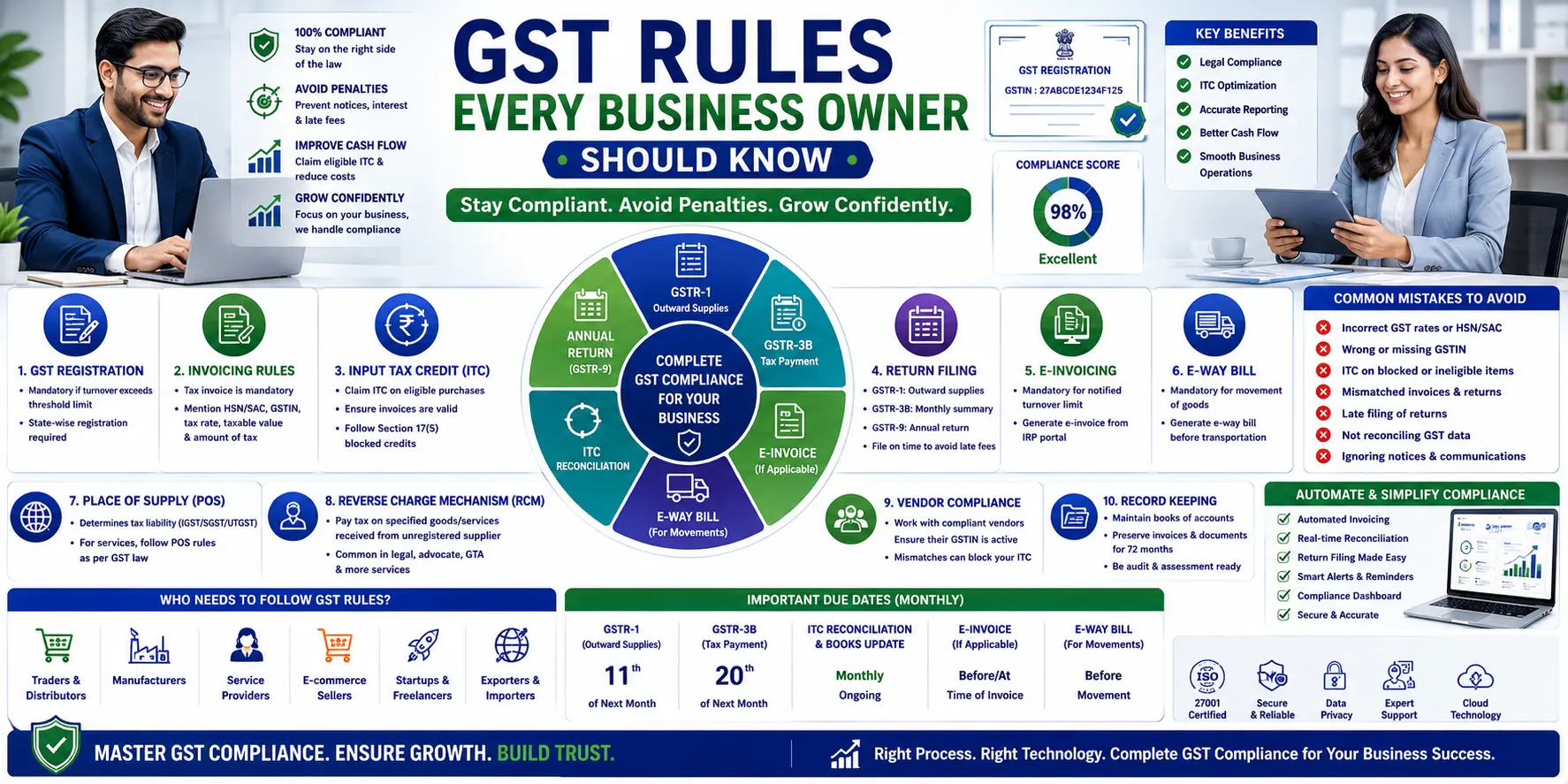
The Goods and Services Tax is really important for businesses in India. This article talks about the things that every business owner should know about the Goods and Services Tax like how to register and get tax credits and what to do with e-invoicing and e-Way Bills. This will help businesses follow the rules and grow. We will give you examples and tips to help you avoid making mistakes with the Goods and Services Tax and getting penalties.
The Goods and Services Tax changed the way taxes work in India on July 1 2017. It replaced a lot of taxes that the central and state governments used to charge. Now the Goods and Services Tax is charged on the goods and services that businesses supply. This makes things simpler because it is a tax structure. Every business owner, in India needs to understand the Goods and Services Tax to make sure they are following the rules and to help their business grow.
Introduction to GST and Its Significance
GST is a destination-based, multi-stage tax that is collected at every stage of value addition. Its introduction was aimed at consolidating several indirect taxes and reducing cumbersome tax complications. For business owners, understanding GST is vital for better financial planning and avoiding compliance issues.
Key Concepts Every Business Owner Should Know
1. GST Registration Requirements
Businesses must register for GST if their aggregate turnover exceeds Rs. 20 lakh (Rs. 10 lakh in special category states). Registration is crucial as it provides a GSTIN that allows entrepreneurs to collect tax and avail Input Tax Credits (ITC).
2. Aggregate Turnover Thresholds
The aggregate turnover threshold is essential to determine when a business is liable to register and comply with GST. Regular monitoring ensures businesses remain compliant and benefit from GST credits.
3. GST Rates, HSN/SAC Codes
Understanding applicable GST rates based on HSN (Harmonized System of Nomenclature) codes for goods and SAC (Services Accounting Code) for services is crucial for accurate tax computation and compliance.
4. Invoicing Rules
Compliance with invoicing rules, including displaying required information such as GSTIN, details of goods/services, and tax amounts, is critical for every GST-compliant transaction. E-invoices are necessary for businesses exceeding specified turnover thresholds.
5. GST Return Filing Obligations
Regular filing of GST returns helps maintain records and ensures compliance with tax authorities. Different return forms, such as GSTR-1, GSTR-3B, and annual GSTR-9, must be filed timely to avoid penalties.
Important Topics for Compliance
Input Tax Credit (ITC) Eligibility
ITC allows businesses to reduce the tax paid on inputs from their GST liabilities. Ensuring proper documentation and compliance with rules, such as blocked credits under Section 17(5), is essential for claiming ITC.
E-Invoicing Applicability and e-Way Bills
E-invoicing applies to businesses with a turnover exceeding a specified limit, ensuring real-time reporting of transactions. E-Way Bills facilitate the movement of goods, mitigating tax evasion risks.
Place of Supply Rules and Reverse Charge Mechanism (RCM)
The place of supply rules determine the state in which GST is applicable. The Reverse Charge Mechanism obliges the recipient, rather than the supplier, to pay GST, affecting compliance and bookkeeping operations.
Annual Return Filing Requirements
Filing annual returns, such as GSTR-9, is mandatory and provides a comprehensive summary of the annual GST activities of a business. Accurate and timely filing is critical to avoiding audits and penalties.
Practical Examples and Common GST Mistakes
Consider a startup providing IT services crossing the threshold and missing GST registration. Such lapses can result in penalties. Conversely, a trader accurate in registration but neglecting correct ITC claims can face financial losses. SMEs and e-commerce firms often overlook vendor compliance, leading to input mismatches. Avoiding common mistakes like incorrect invoicing and late filings can help in smooth GST adherence.
Importance of Accurate Records and Automation
Maintaining accurate records and reconciling GST returns are imperative to preventing errors. Monitoring vendor compliance ensures ITC eligibility, and meeting filing deadlines avoids penalties. Using GST software, automation tools, and API integrations can greatly simplify compliance, reduce errors, and improve operational efficiency.
Summary
In conclusion, understanding and adhering to GST rules is vital for every business owner’s financial health and stability in India. By leveraging automation tools and ensuring thorough compliance, companies can focus on growth without the distractions of tax discrepancies and penalties. Investing in GST knowledge and solutions is pivotal for achieving streamlined tax operations and fostering business success.
Meticulously ensuring your business aligns with GST regulations facilitates not only compliance but also smooth operations and, ultimately, contributes to sustainable business growth.
LEDGERS makes GST compliance easy by including reconciliation in the accounting process. This helps businesses find mismatches early and fix them before they cause problems like interest or penalties. LEDGERS also syncs GSTN data automatically. It tracks invoices one by one. Uses the system to check for errors. This way businesses can comply with GST rules accurately. They do not have to make last-minute corrections or follow up manually with LEDGERS. LEDGERS helps businesses, with GST compliance and GST compliance is made easy with LEDGERS.