




PUGALENTHI
Updated on
10-06-2026
GST Rules for Digital Marketing Agencies in India
The digital landscape is changing all the time. So digital marketing agencies in India have to deal with the Goods and Services Tax system. They have to make sure they are doing everything right and paying the amount of taxes.
This includes things like search engine optimization and social media marketing. It also includes pay per click advertising and digital consulting. Digital marketing agencies in India need to understand how the Goods and Services Tax applies to them.
This article is going to take a look at the Goods and Services Tax framework for digital marketing services. It will talk about what digital marketing agencies in India need to do to register and how they should make invoices. It will also talk about tax credits for marketing agencies, in India.
An Introduction to Digital Marketing Services
Digital marketing encompasses a wide array of online services aimed at boosting brand visibility and engagement. Key activities include:
- Search Engine Optimization (SEO)
- Social Media Marketing
- Pay-Per-Click (PPC) Advertising
- Content Marketing
- Influencer Marketing
- Email Marketing
- Website Promotion
- Digital Consulting
Each of these services plays a crucial role in the growth strategy of businesses, and understanding GST implications is important to maintain financial efficiency.
GST Applicability on Digital Marketing Services
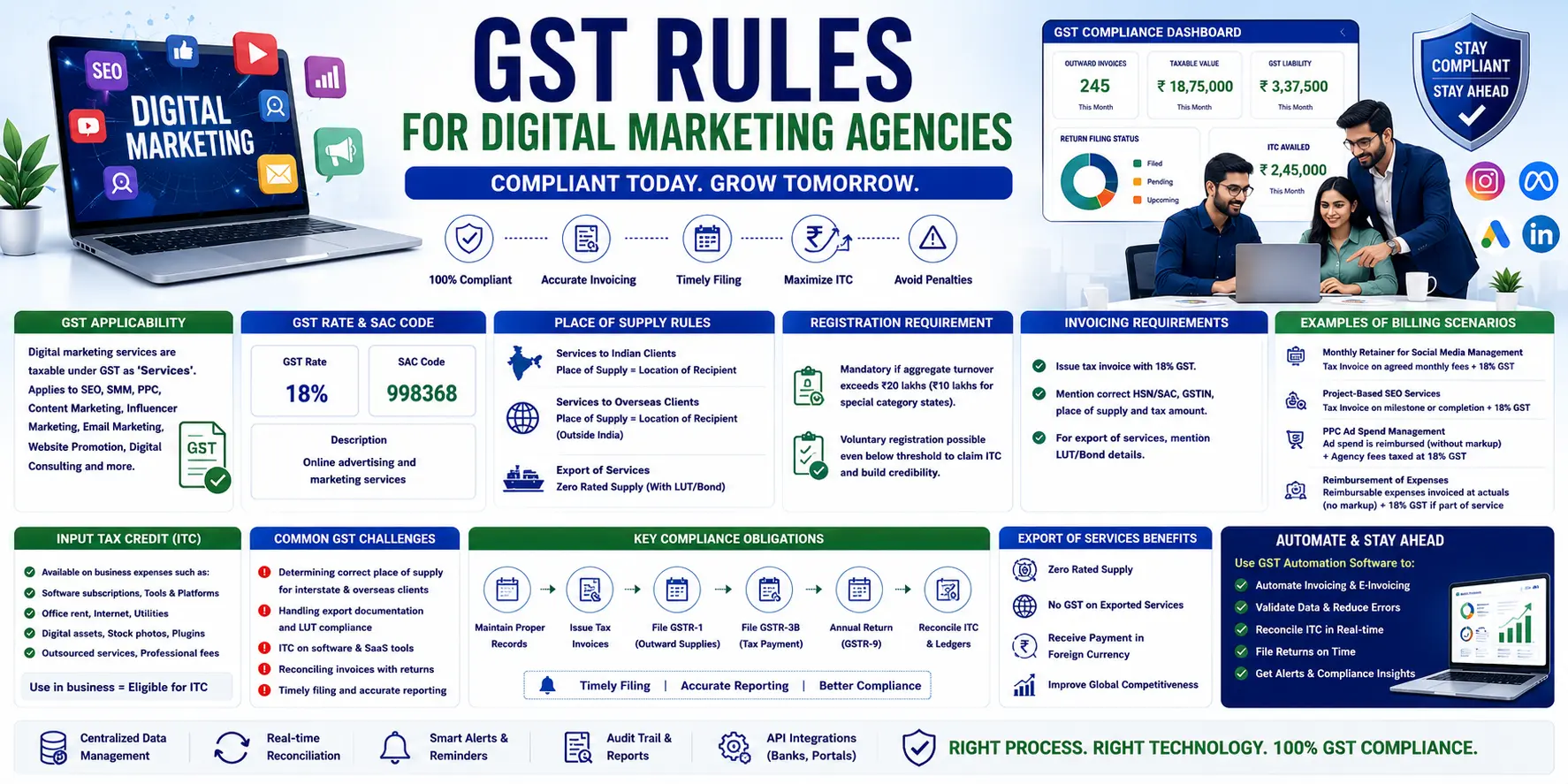
Under the Indian GST regime, digital marketing services are subject to tax as they fall under the classification of 'supply of services.' The key considerations include:
- Registration Requirements: Digital marketing agencies with an annual turnover exceeding INR 20 lakhs (INR 10 lakhs in special category states) must register for GST.
- Applicable GST Rates: The standard GST rate for digital marketing services is 18%.
- SAC Codes: Services are categorized under specific Service Accounting Codes (SAC), with digital advertising typically falling under SAC 998361.
Place of Supply Rules
Place of supply denotes the location of service delivery, which determines the applicable GST rate. For digital marketing services:
- Domestic Clients: Intra-state service provisions attract Central GST (CGST) and State GST (SGST), while inter-state services are levied with Integrated GST (IGST).
- Overseas Clients: Services rendered to foreign clients fall under âexport of services,’ commonly treated as zero-rated under the Letter of Undertaking (LUT) policy.
Invoicing Requirements and Input Tax Credit (ITC)
Proper invoicing is vital for compliance and availing Input Tax Credit:
- Invoicing: Must include GSTIN, invoice number, date, description of services, GST rate, and amount. E-invoicing is mandatory for certain turnovers.
- Input Tax Credit: Agencies can claim ITC for GST paid on procurements like software subscriptions and marketing tools, enhancing cash flow.
Practical Examples of GST Applications
- Retainer-Based Billing: Agencies must add GST on monthly retainer fees, applying the current rate and ensuring proper documentation.
- Project-Based Services: Full project billing involves GST, payable at each milestone or upon project completion, as per contract terms.
- Ad Spend Management: If managing ad spend, GST applies to service fees, not on ad spend itself, differentiating costs for clarity.
- Reimbursement of Expenses: Reimbursements attract GST, requiring separation in invoices to maintain transparency and compliance.
Common Compliance Challenges and Solutions
Digital agencies often face challenges such as:
- Determining Place of Supply: Accurate assessment of client location is critical to apply appropriate GST rates.
- Handling Foreign Clients: Proper documentation ensures that services remain zero-rated under export provisions.
- Claiming ITC on Software: Regular reconciliation to match subscriptions and utilities is essential for tax credit claims.
- Invoice Reconciliation with GST Returns: Discrepancies can lead to compliance issues, hence the need for accurate record-keeping.
Leveraging GST Software and Automation Tools
Utilizing technology can simplify GST management:
- Invoicing and Billing: Automated systems can manage invoicing accurately and efficiently, reducing manual error risks.
- Reconciliation: Automated reconciliation tools match invoices with returns, minimizing discrepancies.
- Return Filing: Software expedites accurate and timely GST return filing, avoiding penalties for non-compliance.
- Compliance Monitoring: Real-time tracking and alerts can preempt compliance issues, ensuring adherence to GST norms.
Best Practices for GST Management
To enhance compliance, digital marketing agencies should focus on:
- Proper Documentation: Maintain comprehensive records of all financial transactions and client agreements.
- Expense Tracking: Keep meticulous records of expenses to facilitate ITC claims and financial audits.
- Managing GST Audits: Prepare thoroughly for audits by ensuring all supporting documents and returns are up-to-date.
- Timely Return Filing: Adhere to filing deadlines to avoid late fees and maintain a clean compliance record.
Conclusion
Digital marketing agencies in India need to handle the goods and services tax carefully. This is so they can follow the law and keep their money in order. If they know how the goods and services tax works for services they will be safer and work better. Using computers to do tasks automatically can really help it makes sending bills easier and checking if they are following the rules simpler. If digital marketing agencies in India do things the way they can focus on giving people really good digital services and also make sure they pay their taxes correctly. Digital marketing agencies, in India have to pay attention to the goods and services tax so they can provide digital services.
LEDGERS makes GST compliance easy by including reconciliation in the accounting process. This helps businesses find mismatches early and fix them before they cause problems like interest or penalties. LEDGERS also syncs GSTN data automatically. It tracks invoices one by one. Uses the system to check for errors. This way businesses can comply with GST rules accurately. They do not have to make last-minute corrections or follow up manually with LEDGERS. LEDGERS helps businesses, with GST compliance and GST compliance is made easy with LEDGERS.