
ATCHAYA M
Updated on 30-07-2026
Many companies keep their accounts separate from billing, as well as billing from filing, with invoice generation taking place during operational hours while an entirely separate activity performed after the end of each month performs GST return preparation. Although keeping track of the billing and filing process separately can work for some companies, this process can leave gaps in the data and inconsistent entries, and requires extra time spent doing reconciliations at month-end.
As companies have more transactions to account for, it becomes impossible to manage billing and filing separately. Missing invoices, incorrect information about the invoice created, and having to create an invoice again at month-end to correct situations that you find to be inaccurate will result. This is why it is critically important to create a connected workflow where billing to and from the GST remains a complete and structured process.
In traditional setups, invoices are often generated in one system, while GST returns are prepared using another tool or manually compiled data. This creates a gap between:
Because of this gap, businesses often spend time:
This process becomes more difficult as the number of transactions increases.
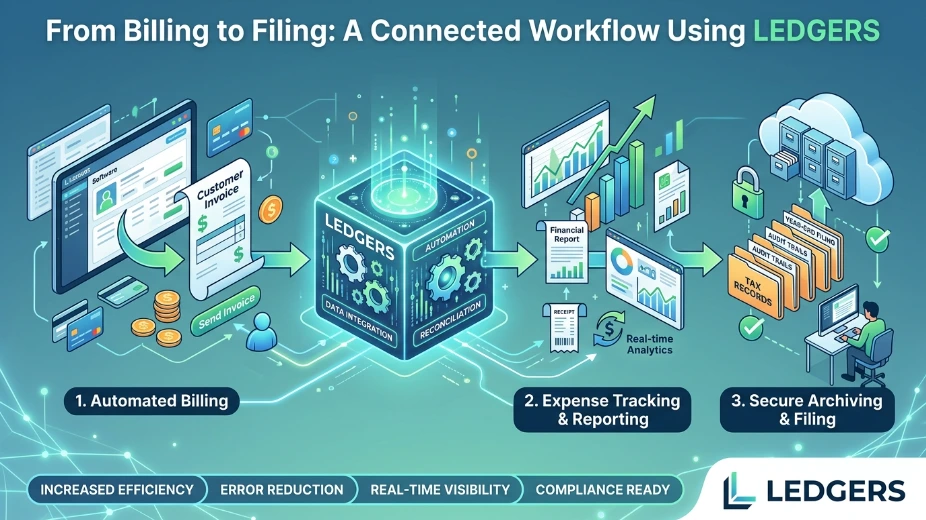
A connected workflow ensures that invoice data flows directly into GST compliance processes without duplication or manual intervention. When billing and filing are linked:
This approach helps businesses move from reactive corrections to proactive management.
Everything starts with accurate invoice generation. When invoices are created correctly, it sets a strong foundation for the entire compliance process.
Key aspects include:
When this data is structured properly at the beginning, it reduces the need for corrections later.
Instead of waiting until the end of the month to check data, a connected workflow includes validation at the time of invoice creation.
This helps identify:
Early validation ensures that only clean data moves forward into GST reporting.
Once invoices are generated and validated, the same data can be used directly for GST return preparation. There is no need to re-enter or recompile data.
This ensures that:
The finance team can focus more on reviewing data rather than collecting it.
Reconciliation is one of the most time-consuming parts of GST compliance. When billing and filing are disconnected, mismatches are common.
A connected workflow reduces these mismatches by ensuring that the same data is used across all processes.
This makes it easier to:
A connected system provides visibility into every stage of the process. Teams can easily track:
This visibility helps in better planning and reduces the chances of delays.
When billing and filing are connected, finance teams spend less time on manual tasks and more time on monitoring and decision-making.
This improves:
It also reduces stress during filing periods.
As businesses grow, the number of transactions increases. A disconnected system becomes difficult to manage at scale.
A connected workflow ensures that:
This helps businesses scale without increasing complexity.
Managing billing and GST filing as separate activities can create inefficiencies and increase the risk of errors. A connected workflow brings these processes together, ensuring that invoice data flows smoothly into compliance tasks.
LEDGERS helps businesses build this connection by integrating billing and GST workflows into a single structured system. By reducing manual effort, improving accuracy, and enhancing visibility, it enables businesses to manage compliance more efficiently and confidently as they grow.
