
ATCHAYA M
Updated on 30-07-2026
Business growth is exciting. More customers, higher transaction volumes, expanding teams, and operations across different locations are all signs of progress. However, as businesses scale, compliance responsibilities also grow along with them. What once felt manageable with simple processes can slowly become difficult to control.
This is especially true for GST compliance. In the early stages, businesses may handle invoicing, tax calculations, and return filing using spreadsheets or small disconnected systems. But as operations expand, these methods often lead to confusion, delays, and errors.
Keeping GST compliance organized during growth is not just about avoiding penalties - it is about building processes that can support long-term business stability.
In a small business setup, GST compliance may involve only a limited number of invoices and transactions. A small finance team can often manage everything manually without much difficulty.
However, growth changes the situation completely. Businesses start dealing with:
As these activities increase, maintaining consistency becomes much harder without structured workflows.
Many businesses continue using the same methods even after scaling operations. While this may work temporarily, it eventually creates operational strain.
Some common issues include:
Over time, these small inefficiencies start affecting overall productivity.
As businesses scale, even minor compliance mistakes can have larger consequences. A small error in a high-volume environment can impact multiple invoices, customers, or reporting periods.
Organized GST compliance helps businesses:
It also allows finance teams to focus on monitoring compliance instead of constantly fixing issues.
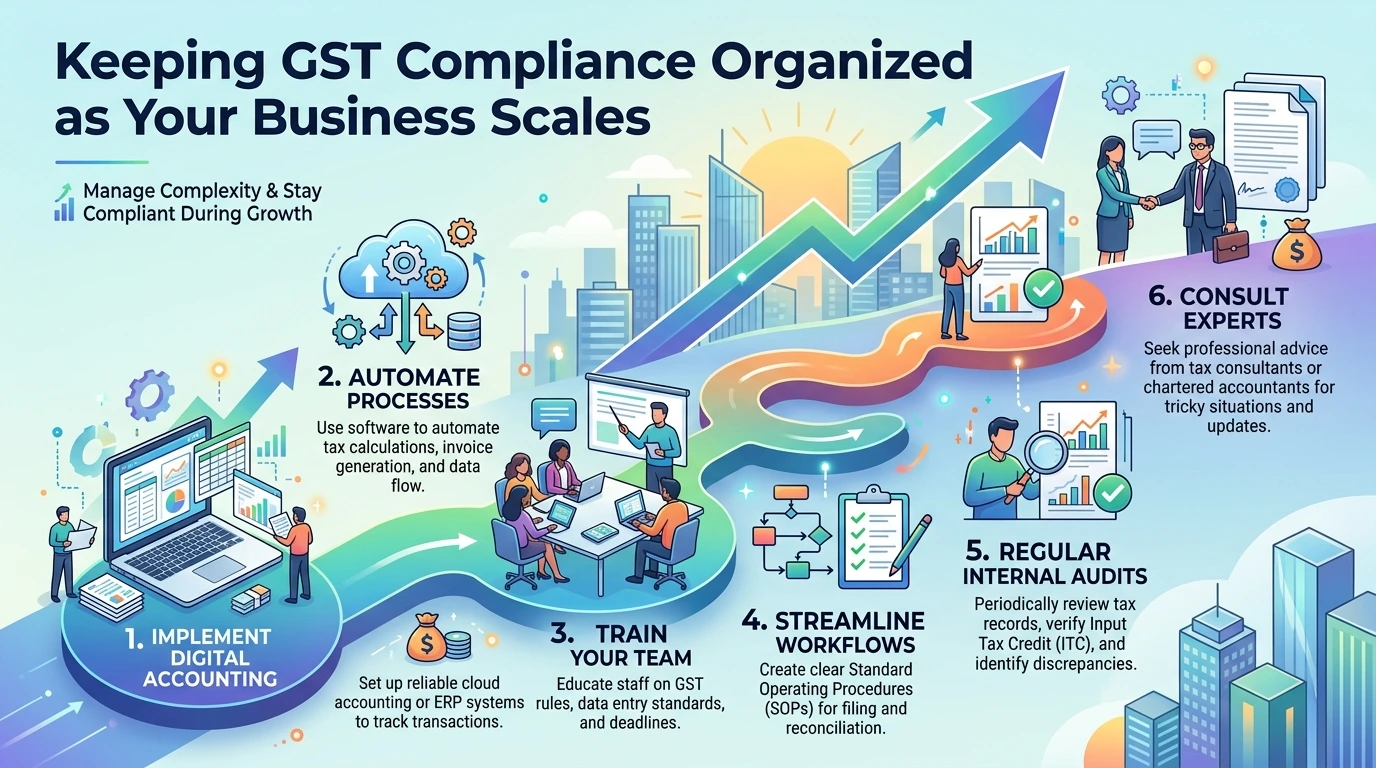
One of the most important steps in scaling compliance successfully is creating structured workflows. Businesses should define how invoicing, approvals, reconciliation, and filing will be handled.
A clear workflow usually includes:
When everyone follows the same process, operations become more predictable and manageable.
As organizations grow, multiple departments start contributing to GST-related activities. Sales teams generate transactions, operations handle delivery details, and finance teams manage invoicing and filing.
Without coordination, inconsistencies can easily arise.
Maintaining centralized and consistent data helps avoid:
This becomes especially important when businesses operate across multiple branches or teams.
Manual processes become difficult to sustain as transaction volumes increase. Repeated data entry, spreadsheet tracking, and manual reconciliation consume time and increase the chances of errors.
Growing businesses benefit from moving toward structured systems that can:
This helps teams manage higher workloads without increasing operational confusion.
As businesses scale, leadership teams also need better visibility into compliance operations. It becomes important to know:
Without clear visibility, businesses may discover problems only when deadlines are close.
A more organized system helps teams track activities in real time and respond quickly when issues arise.
Growing businesses often expand into multiple states, which means handling multiple GST registrations. Managing compliance separately for each GSTIN without a structured approach can become overwhelming.
An organized system helps businesses:
This is critical for businesses planning long-term expansion.
Keeping GST compliance organized is not only about software or processes — it is also about building discipline within teams.
As businesses grow, employees should understand:
When compliance becomes part of daily operational culture, scaling becomes smoother.
Businesses that maintain organized GST processes during growth usually experience:
More importantly, they are able to scale confidently without losing operational clarity.
Business growth brings new opportunities, but it also increases the complexity of GST compliance. Processes that worked for smaller operations may no longer be sufficient as transaction volumes and teams expand.
Keeping GST compliance organized through structured workflows, centralized data management, and reduced manual effort helps businesses maintain accuracy and efficiency as they scale. With the right systems and practices in place, businesses can grow confidently while keeping compliance under control.
