




PUGALENTHI
Senior Developer
Updated on
08-06-2026
GST Compliance for Logistics Businesses
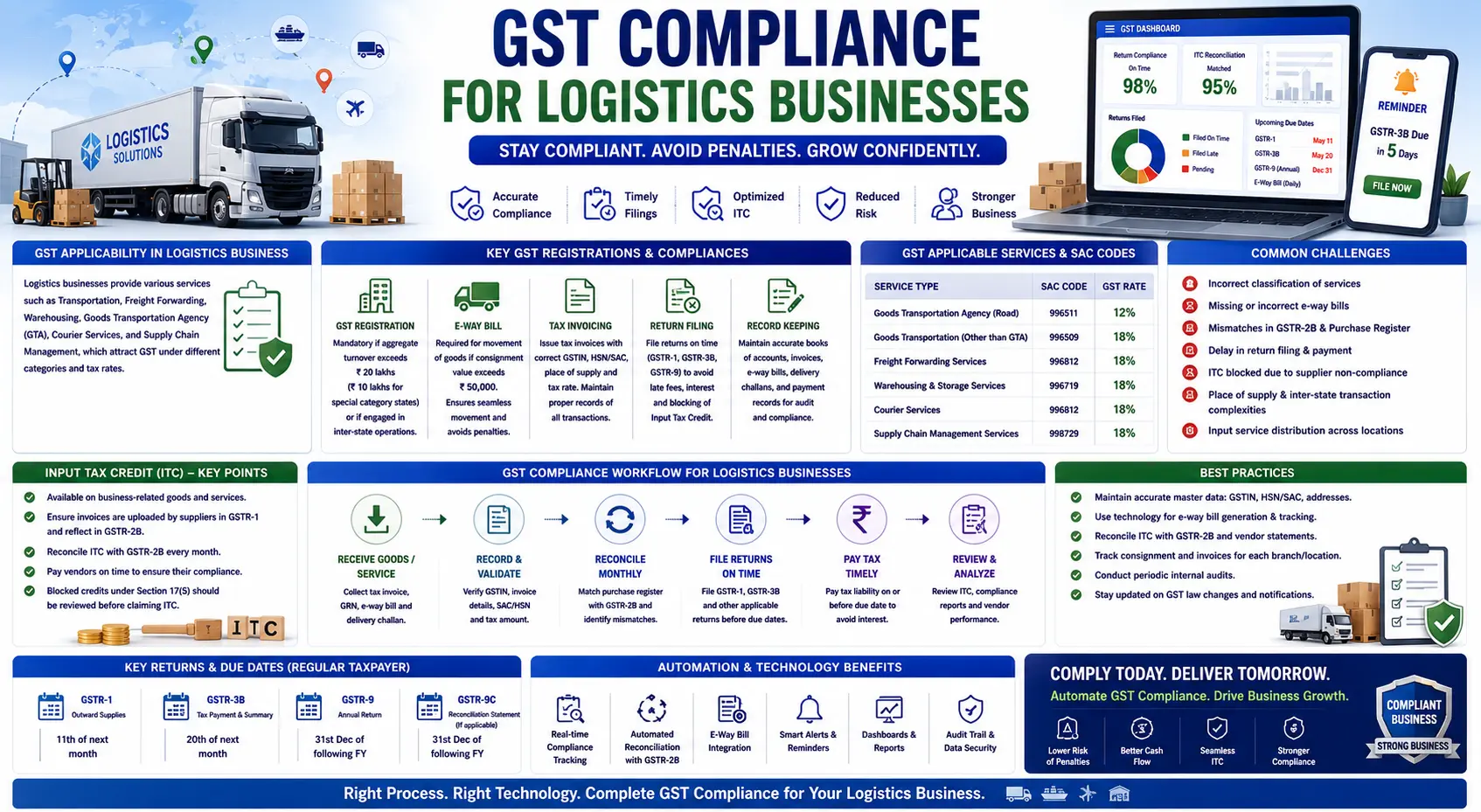
The logistics industry in India is very important for the country's economy. It helps with transportation, warehousing, freight forwarding, courier services and managing supply chains. The Goods and Services Tax or GST has changed how logistics companies work. It provides one tax system for everyone. Logistics companies in India still struggle with following GST rules. This is a problem, for them.
The Role of Logistics in India's Economy
Logistics is integral to efficient supply chain operations, encompassing tasks such as:
- Transportation of goods
- Warehousing
- Freight forwarding
- Courier services
- Supply chain management
These activities depend on seamless coordination and efficiency, which GST aims to standardize by reducing the complexity of various indirect taxes.
How GST Applies to Logistics Businesses
The GST framework requires logistics businesses to adhere to specific rules and regulations. Key aspects include:
GST Registration Requirements
Logistics businesses with an annual turnover exceeding ₹20 lakh (10 lakh for special category states) must register for GST. This registration allows them to collect GST and claim Input Tax Credit (ITC).
Applicable Tax Rates
The GST rates applicable to logistics services largely fall under the 18% tax slab. However, certain auxiliary services might attract different rates based on specific conditions.
SAC Classifications
Logistics companies provide lots of services. These services are grouped under codes called Service Accounting Codes or SACs for short. The Service Accounting Codes determine what tax rate we have to pay, which is the GST rate. So it is very important that we classify our services under the right Service Accounting Codes. This way we can make sure we are paying the amount of tax and following all the rules. Logistics companies need to get this right to avoid any problems, with tax.
Place of Supply Rules
Understanding the 'place of supply' is crucial for tax determination. For transportation services, the place of supply is typically the location of the recipient. Errors in this determination can lead to significant tax liabilities.
Invoicing Requirements
Logistics companies must issue GST-compliant invoices containing details like GSTIN, SAC code, and tax breakdown. Proper invoicing ensures smooth input tax credit claims and reduces compliance risks.
Key Compliance Areas for Logistics Businesses
e-Way Bills
e-Way Bills are mandatory for transporting goods valued over â¹50,000. Ensuring accurate documentation and timely generation of e-Way Bills is critical to avoid penalties.
GST Return Filing
Logistics companies must file regular GST returns, detailing sales, purchases, and tax paid. Timely and accurate filings prevent interest and late fee liabilities.
Input Tax Credit (ITC) Eligibility
Claiming ITC is essential for reducing tax payable. Logistics providers must ensure that all inputs are GST compliant to maximize ITC benefits.
Interstate Transactions
Logistics businesses often operate across state lines, requiring a clear understanding of inter-state GST transactions and compliance obligations.
Branch Transfers
Intra-entity transfers of goods between branches in different states necessitate proper documentation and compliance with GST rules.
Vendor Compliance Management
Ensuring vendors are GST-compliant and their invoices are valid is essential for seamless ITC claims and overall compliance.
Practical Examples for Logistics Providers
A freight forwarding company that works in states has a lot of things to take care of. They have to deal with transactions that happen between states they have to keep track of e- Bills and they have to make sure they are filing their GST on time all the time.
When it comes to the people who provide warehouse services they usually have a lot of items in stock. They have to make sure their invoices are correct. They also have to be very careful when they are managing their Input Tax Credit.
The people who operate the transport have to make eWay Bills quickly and they have to match them with their GST returns so that there are no mistakes. Freight forwarding companies like these have to do this to avoid problems with their GST returns and freight forwarding work. Transport operators and freight forwarding companies need to do this to minimize discrepancies, in their GST returns and freight forwarding work.
Common GST Compliance Challenges
Logistics companies frequently face challenges such as:
- e-Way Bill mismatches across states
- Incorrect place-of-supply determinations
- ITC reconciliation issues due to vendor non-compliance
- Managing compliance across multiple locations
Leveraging Technology for GST Compliance
Adopting GST software and automation tools can significantly streamline operations:
- API Integrations: Connect and sync systems for automated billing and report generation.
- Automation Tools: Simplify repetitive tasks like e-Way Bill generation and invoice validation.
- Reconciliation Systems: Ensure ITC claims are accurate and discrepancies are resolved quickly.
Best Practices for GST Compliance in Logistics
- Maintain accurate and up-to-date records to facilitate easy verification and audits.
- Ensure timely return filings to prevent penalties and interest charges.
- Validate invoices meticulously to enable correct ITC claims.
- Conduct regular GST audits to identify and rectify potential compliance issues early.
Conclusion
GST compliance for logistics businesses in India is really important. You need to know the tax rules well and manage things in a good way. There are some problems. If you use technology and do things the right way you can actually use compliance to help your business grow and work better.
Logistics companies can do a things to make GST compliance easier. They can use machines to do tasks. They can make sure all their documents are correct.. They can file their taxes on time. By doing these things logistics companies can deal with the complicated GST rules. Be successful in a very competitive industry. GST compliance is key for logistics businesses, in India.
LEDGERS
LEDGERS makes GST compliance easy by including reconciliation in the accounting process. This helps businesses find mismatches early and fix them before they cause problems like interest or penalties. LEDGERS also syncs GSTN data automatically. It tracks invoices one by one. Uses the system to check for errors. This way businesses can comply with GST rules accurately. They do not have to make last-minute corrections or follow up manually with LEDGERS. LEDGERS helps businesses, with GST compliance and GST compliance is made easy with LEDGERS.