




PUGALENTHI
Updated on
05-06-2026
How to Avoid ITC Mismatches Under GST
Businesses in India rely heavily on the Input tax credit (ITC) mechanism to decrease their tax liabilities by taking credits for taxes they pay when buying goods & services through the Goods and Services Tax ("GST"). Businesses often run into trouble with mismatched input tax credits (ITC) because they can lead to the denial of your ITC claim, tax authority notices, penalties, and additional taxes owed. Therefore, it is important for businesses to know how to avoid mismatched ITCs in order to correctly comply with GST Regulations while maximizing their ability to utilize credits.
The Importance of ITC Under GST
The GST status allows for the deduction of your Input Tax Credits (ITC) from the total amount due for each accounting period and allows for these deductions to be applied to your future GST debts. Because of this, it is critically important that businesses maintain accurate records with respect to their ITC claims; any discrepancies between your GST return or your documentation will result in significant financial penalties and/or compliance issues.
Common Causes of ITC Mismatches
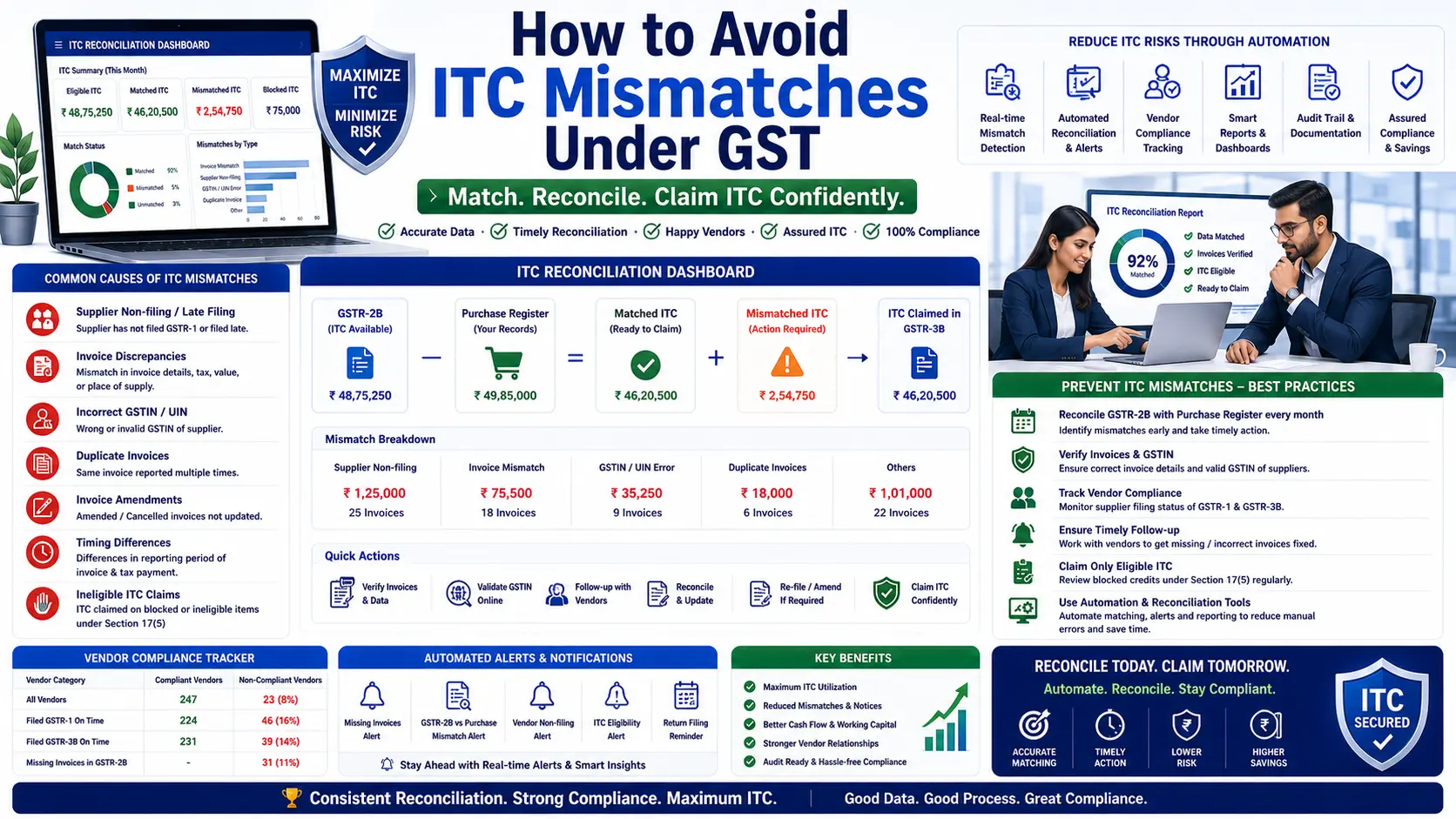
To effectively avoid ITC mismatches, understanding their common causes is essential. These causes include:
Non-filing of supplier returns: If suppliers do not file their returns or inaccurately report their invoices on their GSTR-1 returns, an ITC claim may be denied.
The discrepancies between GSTR-2B and purchasing registers: Many discrepancies occur between auto-generated sales return forms (GSTR-2B) and actual purchases, which cause mismatches.
Incorrect GST Numbers: Any mistake made when entering a supplier's GST number will result in a mismatch, as the taxation system will not verify the transaction.
Duplicate Sales Invoices: Claiming ITC on duplicate invoices creates discrepancies and can trigger an audit notice from the relevant authority.
Amended Invoices: If the original invoice is amended, and this is not captured timely in the data, there will be subsequent mismatches in the total transactions.
Timing: If a supplier does not match the timing of a transaction or receipt to that of the supplier, there will, again, be discrepancies in the total transactions.
Ineligible ITC: Significant compliance issues arise when ITC is claimed for items where the provisions of GST do not permit claims.
Identifying and Preventing ITC Mismatches
Businesses can minimize risks by actively identifying and preventing ITC mismatches through various strategies:
Regular Reconciliation
Regular reconciliation of purchase records, GSTR-2B, GSTR-3B & vendor data, is very important to establish your organization's compliance with these documents, help you find errors in these types of documents before you file returns, and help you take corrective action prior to filing.
Timely Identification - Frequent reconciliation helps you identify incorrect information in advance so that you can take timely corrective action.
Mistake Correction - Frequent reconciliation will also help you fix inaccurate GSTINs and amounts, which will also help reduce the number of mismatches for your business.
Vendor Compliance Tracking
Monitoring vendor compliance is crucial. Businesses should ensure their suppliers file their GST returns (GSTR-1) on time to avoid mismatch issues. Companies can:
- Conduct periodic vendor performance reviews.
- Establish effective communication channels for timely issue resolution.
Leveraging Technology and Automation
Technology plays a significant role in reducing ITC mismatch risks. Here’s how businesses can utilize software solutions:
GST Software and APIs
Deploying advanced GST software and Application Programming Interfaces (APIs) enables businesses to automate reconciliation processes. Benefits include:
- Real-Time Detection: Automated tools provide real-time alerts for any discrepancies detected.
- Efficient Resolution: Enables quick corrective actions through integrated reconciliation platforms.
Automation Tools
Automated solutions reduce human errors and streamline ITC processes. They offer:
- Seamless integration with accounting and purchase systems.
- Automated data matching and validation capabilities.
Best Practices for Effective ITC Management
Implementing best practices can help businesses maintain robust ITC management:
- Monthly Reconciliation: Regular monthly checks of all financial and tax-related data ensure accuracy and compliance.
- Supplier Follow-Ups: Stay in constant contact with suppliers to ensure they file accurate and timely returns.
- Accurate Master Data Maintenance: Maintain up-to-date and accurate data, including GSTINs and invoicing details, to prevent entry errors.
- Documenting ITC Claims: Keep thorough documentation of all ITC claims to support claims during audits or investigations.
- Reviewing Blocked Credits: Regularly evaluate blocked credits under Section 17(5) of the GST Act to avoid erroneous claims.
Conclusion
To prevent an ITC mismatch under GST will be important as a business. To do this correctly will involve understanding the causes of mismatches, reconciling your accounts regularly, monitoring your supplier's compliance, and utilising technology in your operations. Choosing to adopt best practices is a way to provide the business with the opportunity to improve their ITC process and to reduce exposure to any potential risk of compliance or financial penalties. In addition, choosing to use automated solutions and maintain accurate records will further improve the business's ability to manage their GST and ITC processes in an efficient manner. It is essential for companies to use proactive measures and to incorporate technology during this process to achieve the most accurate GST compliance and maximum benefits from the input tax credit process.
LEDGERS assists with compliance relating to GST through the integration of reconciliations into your accounting processes to allow the speedy identification of errors in records prior to incurring any penalties or interest. LEDGERS allows you to automate the process of synchronizing your GSTN data and tracking invoices on an invoice-by-invoice basis eliminating the need for manual corrections and the time-consuming process of verifying transactions at the end of a reporting period through the use of automatic validations from the system to facilitate revenue compliance activities.