
PUGALENTHI
Updated on 30-07-2026
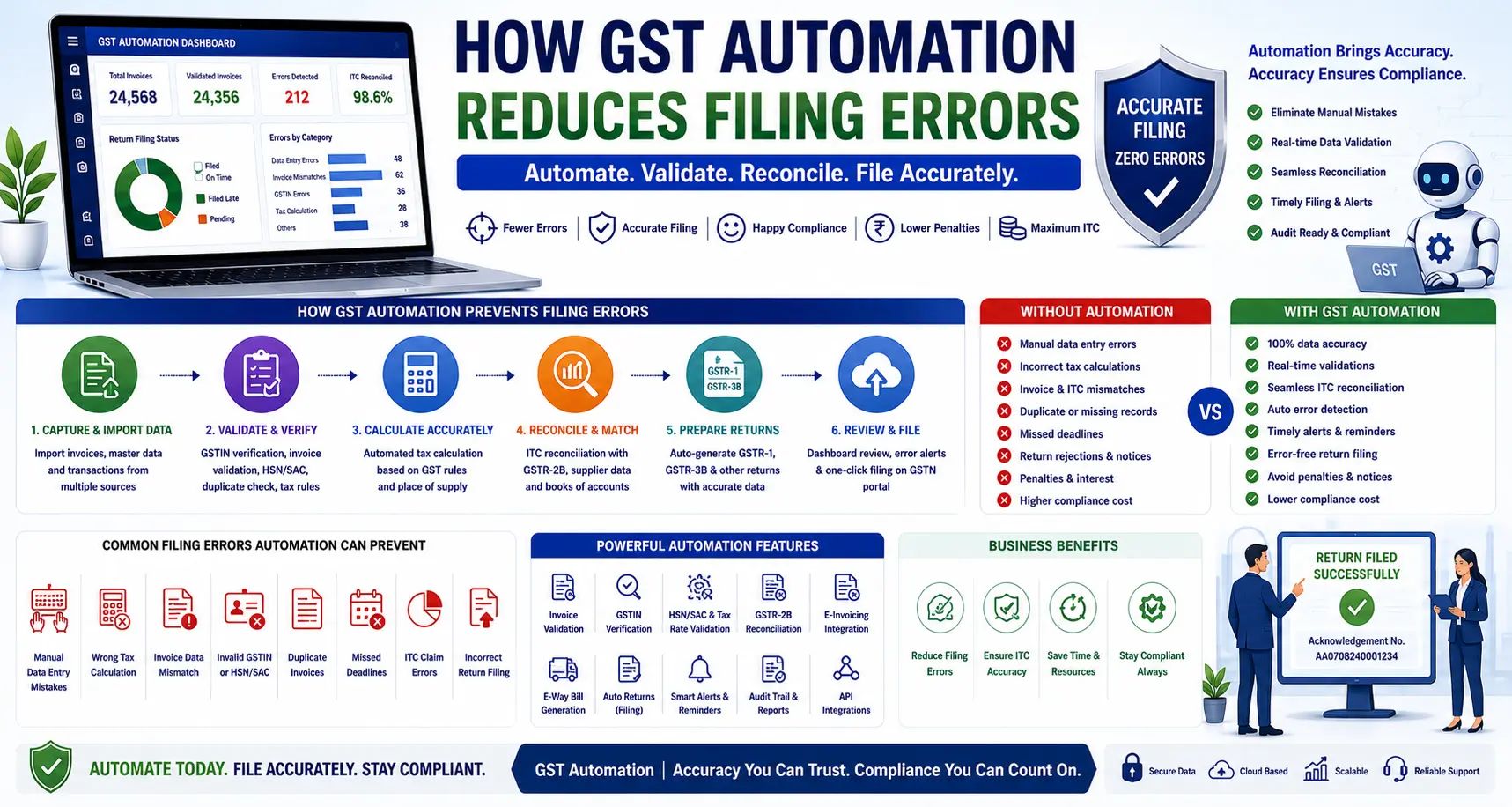
In todays world companies are feeling a lot of stress to get their GST filings right on time. Following the Goods and Services Tax rules is tough. Businesses often struggle with things, like typing in wrong numbers calculating tax incorrectly invoices not matching up having duplicate records missing deadlines and having trouble reconciling accounts. These problems can lead to notices and fines. Also block Input Tax Credit and increase compliance costs.
Lets look at how automating GST can help reduce mistakes when filing and make it easier to comply.
Before delving into the realm of automation, it’s vital to comprehend the typical obstacles businesses face during GST filing:
Filing errors can have cascading effects. Notices from tax authorities disrupt business operations, while penalties and blocked ITC increase costs. The struggle to maintain compliance can also drain resources and reduce efficiency.
GST automation has emerged as a transformative solution to these challenges, offering an array of tools to enhance accuracy and efficiency:
Automation software checks each invoice against regulations, confirming accuracy before submission. It verifies GST Identification Numbers (GSTIN) in real-time, reducing invalid or mismatched entries.
Automated systems apply the correct tax rates and codes, ensuring precise calculations. This eliminates the risk of underpayment or overpayment of taxes.
Automation aids in the preparation of GSTR-1 and GSTR-3B returns, aggregating data accurately and reducing human intervention errors.
GST automation tools facilitate seamless reconciliation of ITC, cross-verifying purchase data against GSTR-2A, enhancing claim accuracy.
The automated generation of e-invoices and e-way bills aligns with regulatory requirements, ensuring uniformity and reducing manual errors.
A retailer that is not too big and not too small was having a lot of problems, with invoices that did not match. When they started using a computer program to help with taxes they had a lot mistakes. The program checked everything as they typed it in and pointed out problems before they sent it in.
A big company that makes things also used a computer program to help with taxes. The program helped them match up all of their purchase records with the tax information they got from the government. This helped them get the amount of money back when they paid their taxes. The company was able to match up 98 percent of their purchase records with the tax information. This really helped the company get the amount of money back.
From small and medium enterprises (SMEs) to large corporations, GST automation levels the playing field, facilitating:
To harness the full potential of GST automation, businesses should consider the following best practices:
In conclusion, GST automation represents a critical advancement in modern tax compliance. By leveraging these technologies, businesses can significantly reduce filing errors, optimize ITC claims, and enhance their overall compliance posture. Embracing automation not only mitigates immediate risks but also positions companies for sustained operational excellence in the dynamic tax landscape.
LEDGERS makes GST compliance easy by including reconciliation in the accounting process. This helps businesses find mismatches early and fix them before they cause problems like interest or penalties. LEDGERS also syncs GSTN data automatically. It tracks invoices one by one. Uses the system to check for errors. This way businesses can comply with GST rules accurately. They do not have to make last-minute corrections or follow up manually with LEDGERS. LEDGERS helps businesses, with GST compliance and GST compliance is made easy with LEDGERS.
