




ATCHAYA M
Updated on
30-07-2026
e-Invoicing for Service Providers: Key Differences and Common Mistakes
E-invoicing was implemented under the Goods and services tax (GST), while it was easy for businesses involved in selling goods to adapt to e-invoicing due to their existing billing cycle, the use of physical movement and delivery of products, and other reasons. Service providers have a different challenge in adapting to e-invoicing. Unlike goods, services are intangibles, continuous, and typically billed based on cycles. Billing has much confusion as it relates to compliance, timing, and classification of service e-invoices.
In order to avoid reporting errors, and issuing unnecessary corrections at a later date, it is important for service providers to understand how e-invoicing applies to them.
How Service Invoices Differ from Goods Invoices
The major difference in regard to invoicing for goods versus invoicing for services is the supply, which most often corresponds to the delivery/discharge of goods, while the supply of services tends to the completion of tasks, milestones, or billing cycles. Examples are as follows.
- A monthly retainer might be billed by a consultant.
- A subscription to a software product might typically have an annual billing date.
- A contractor might bill based on completed milestones.
In all of these examples, the tax point is extremely important (it is referred to as the time the supply is made).
Understanding Time of Supply for Services
For service providers, the time of supply generally depends on:
- The date of invoice, or
- The date of payment, whichever is earlier
This can become tricky when:
- Advance payments are received
- Services are billed in arrears
- Milestones are completed across months
If the timing is misunderstood, businesses may:
- Generate IRN too late
- Report revenue in the wrong tax period
- Create mismatches in GST returns
Being clear about when the invoice should be raised helps prevent downstream compliance issues.
Importance of Correct SAC Classification
While goods use HSN codes, services are classified under SAC (Service Accounting Codes). Incorrect SAC usage is one of the most common mistakes made by service providers under e-Invoicing.
Errors often happen when:
- Generic SAC codes are reused for different services
- Tax rates are applied incorrectly
- Mixed service types are billed under one classification
Since e-Invoice validation checks include service classification consistency, using the correct SAC code ensures smoother IRN generation and accurate GST reporting.
Recurring and Subscription-Based Billing Challenges
Many service businesses operate on recurring billing models. This includes:
- Monthly retainers
- Subscription platforms
- Annual maintenance contracts
- Licensing agreements
In such cases, businesses must ensure:
- Each billing cycle has a separate invoice
- IRN is generated for every invoice (if applicable)
- Revenue recognition aligns with GST reporting
A common mistake is attempting to consolidate multiple billing cycles into one invoice or modifying an invoice after IRN generation, which can complicate compliance tracking.
Handling Advances and Adjustments
Service providers frequently receive advance payments. Under GST, advances for services are taxable at the time of receipt in certain scenarios. This creates questions around:
- Whether to issue receipt vouchers
- When to generate final invoice
- How to adjust tax already paid on advances
Failure to handle advances correctly can result in duplicate tax reporting or incorrect liability calculation.
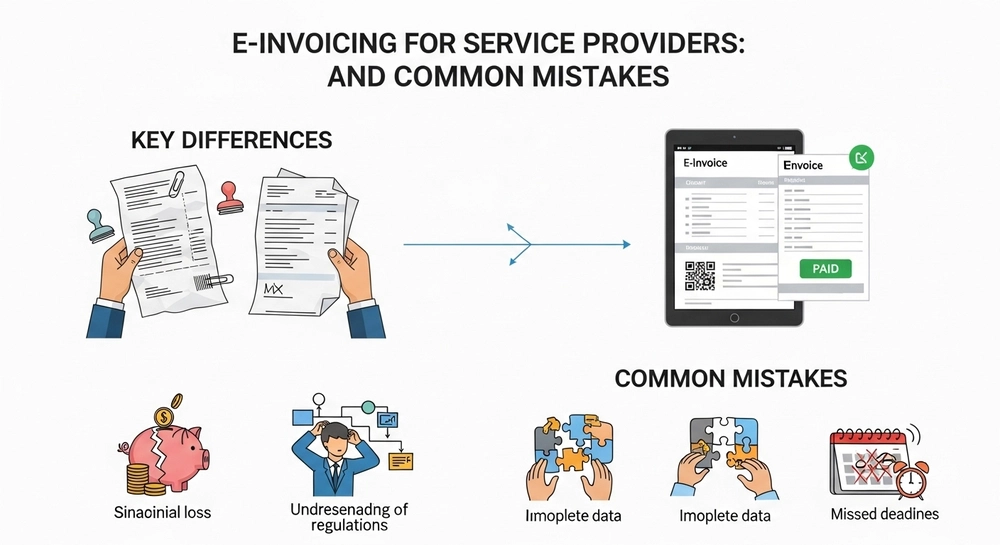
Common Mistakes Service Providers Make in e-Invoicing
Based on practical experience, some recurring errors include:
- Generating IRN before finalizing service value
- Using incorrect place of supply for interstate services
- Confusing export of services with domestic supply
- Failing to issue proper credit notes for service revisions
- Missing linkage between service period and invoice date
These issues often surface during return filing or customer reconciliation rather than at the time of invoice generation.
Export of Services Under e-Invoicing
Service exporters face additional considerations such as:
- Zero-rated supply classification
- LUT compliance
- Foreign currency billing
- Place of supply rules
Mistakes in these areas can delay refund claims or create reporting discrepancies.
Why Structured Invoicing Matters for Service Businesses
Service-based businesses may not deal with physical goods, but their compliance responsibility is equally significant. Clear documentation, correct classification, and disciplined billing cycles reduce confusion and strengthen long-term compliance stability.
A structured e-Invoicing system helps service providers:
- Maintain consistent billing practices
- Avoid last-minute corrections
- Ensure accurate SAC classification
- Align invoicing with GST return periods
Conclusion
E-Invoicing for service providers comes with its own set of nuances. The absence of physical movement makes timing, classification, and billing discipline even more important. By understanding time of supply rules, using correct SAC codes, and managing recurring billing carefully, service businesses can avoid common compliance pitfalls.
With a systematic approach to invoicing and clear internal processes, service providers can handle e-Invoicing confidently while maintaining accuracy in GST reporting and financial records.