
ATCHAYA M
Updated on 30-07-2026
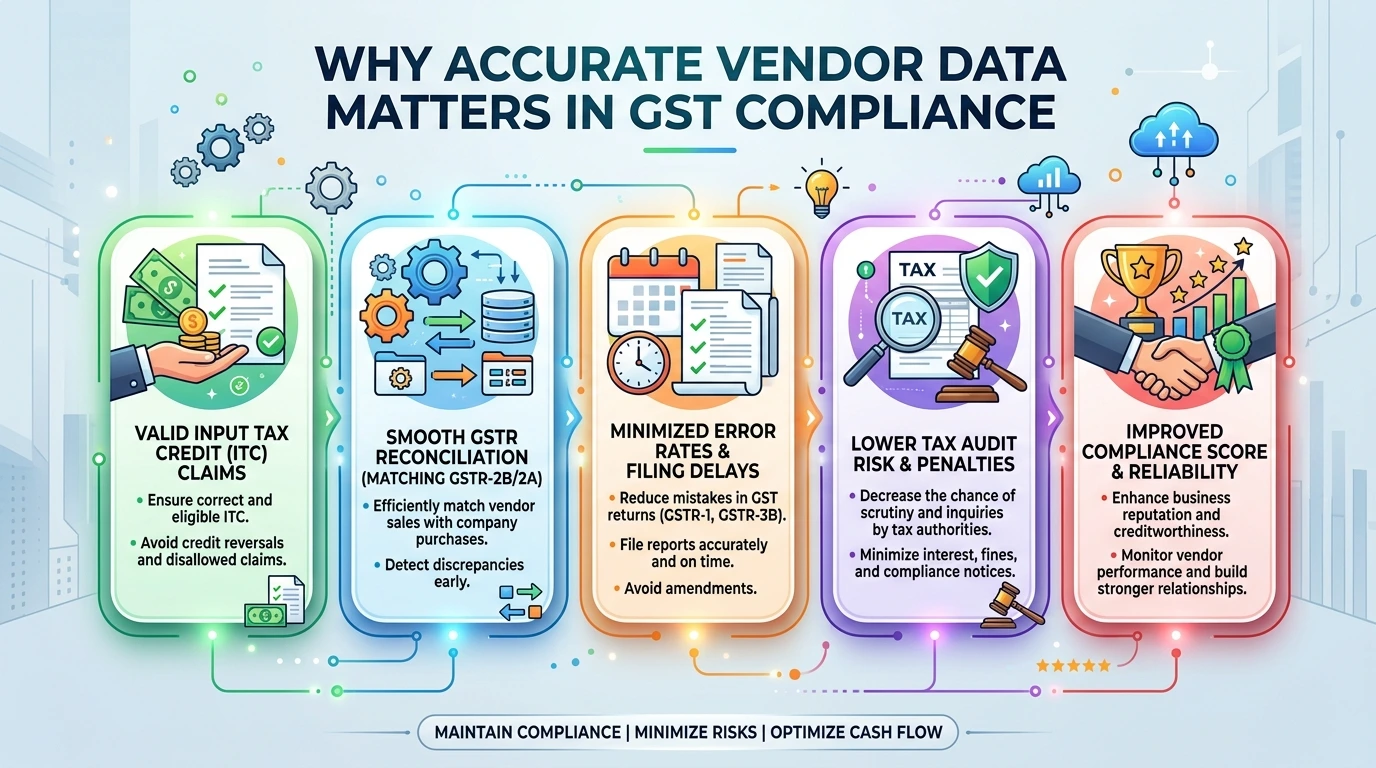
In GST compliance, businesses usually focus heavily on sales invoices, return filing, and tax payments. However, one area that quietly affects the entire compliance process is vendor data. Many GST-related mismatches, ITC issues, and reconciliation problems actually begin with incorrect or incomplete vendor information.
Vendor data includes details such as GSTIN, legal business name, address, place of supply, and tax-related information. If these details are inaccurate, even correctly generated purchase transactions may create compliance issues later.
As businesses grow and work with more suppliers across different states, maintaining accurate vendor records becomes increasingly important. Clean vendor data not only supports smoother GST filing but also improves overall financial accuracy and operational efficiency.
Vendor data refers to the information businesses maintain about their suppliers for accounting and GST purposes.
This usually includes:
These details are used repeatedly during purchase entry, invoice verification, ITC reconciliation, and GST reporting.
Every purchase invoice recorded by a business depends on vendor information. If the vendor data itself is incorrect, the issue affects multiple areas of GST compliance.
Inaccurate vendor data can lead to:
Even a small mistake in vendor details can create larger compliance complications later.
One of the most common vendor data errors is incorrect GSTIN entry. This may happen due to manual typing mistakes, outdated records, or duplicate vendor creation.
An incorrect GSTIN can result in:
Since GSTIN is one of the key identifiers in GST compliance, even a single digit error can affect the entire transaction.
Sometimes businesses update vendor names manually without properly matching them to GST registration details. This creates inconsistencies between invoices and official records.
During reconciliation or audits, mismatches between:
can create confusion and additional verification work.
Maintaining consistency in vendor naming practices helps reduce such issues.
Input Tax Credit depends heavily on supplier compliance and accurate invoice matching. If vendor records are incorrect, businesses may struggle with:
Incorrect vendor details can also make it difficult to trace supplier-uploaded invoices properly.
As businesses grow, the number of vendors increases significantly. Without proper management, vendor records often become cluttered with:
Over time, this creates confusion for finance teams during invoice processing and reconciliation.
Many businesses still maintain vendor information manually through spreadsheets or unstructured systems. This increases the chances of:
Manual management becomes difficult as transaction volumes and vendor count increase.
Vendor data should not be treated as permanent information. Businesses should review vendor records regularly to ensure accuracy.
Regular review helps identify:
Periodic cleanup improves the overall quality of GST records.
GST compliance does not depend only on internal processes. Supplier behavior also affects purchase reporting and ITC accuracy.
Businesses should maintain proper communication with vendors regarding:
Strong vendor coordination helps reduce mismatches and reconciliation issues.
Maintaining clean vendor records benefits more than just GST filing. It also improves:
When vendor information is organized properly, finance teams spend less time fixing errors and more time managing operations efficiently.
Accurate vendor data makes reconciliation significantly easier. When purchase records and supplier details match correctly:
This reduces month-end pressure on finance teams.
Businesses that maintain disciplined vendor management practices usually experience fewer compliance issues over time. Clean vendor data supports:
Small improvements in vendor data management can create long-term operational benefits.
Accurate vendor data plays a crucial role in GST compliance, even though it is often overlooked. Incorrect GSTINs, inconsistent records, and outdated supplier information can create ITC mismatches, reconciliation problems, and unnecessary compliance risks.
By maintaining clean vendor records, performing regular data reviews, and improving vendor coordination, businesses can simplify GST processes and improve overall financial accuracy. A structured approach to vendor data management helps create smoother compliance workflows and stronger operational control as businesses grow.
