




ATCHAYA M
Updated on
30-07-2026
Lessons Businesses Learn After One Year of e-Invoicing Adoption
Originally when e-Invoicing was introduced numerous companies were unsure of how to approach this new way of invoicing due to their uncertainty as to whether it would create more compliance issues for them or whether it would require substantial changes to their current processes, as well as provide them with the necessary training for their employees to feel confident in using e-Invoicing in the future.
But after a year or more of being operation through e-Invoicing, most companies now have different views of e-Invoicing than what they originally did. What started out to be a complicated procedure has now become part of their everyday operations. Most importantly, companies have also learned some valuable real-world lessons about improving both their compliance with the e-Invoicing Program, as well as improving their overall financial discipline.
Initial Resistance Is Normal — But Temporary
Almost every business experience some level of resistance when adopting e-Invoicing. Teams that are used to manual or semi-digital processes may find it difficult to adjust in the beginning.
Common concerns include:
- Fear of making mistakes
- Lack of familiarity with IRN generation
- Uncertainty about compliance rules
However, once teams start using the system regularly, these concerns gradually reduce. Within a few months, most users become comfortable with the process.
Accuracy at the Source Matters More Than Ever
One of the biggest lessons businesses learn is that correcting errors later is much harder than getting things right at the beginning.
Since e-Invoicing validates data early, mistakes such as:
- Incorrect GSTIN
- Wrong tax calculation
- Missing invoice details
are identified quickly. Businesses realize that maintaining clean and accurate data from the start saves time and effort later.
This leads to better data discipline across the organization.
Structured Processes Reduce Daily Stress
Before e-Invoicing, many businesses relied on flexible invoicing practices. While this allowed quick billing, it often created confusion during reconciliation and return filing.
After adopting e-Invoicing, businesses naturally move toward structured workflows. Over time, this structure reduces:
- Last-minute corrections
- Repeated data checks
- Confusion between teams
What initially feels like a restriction eventually becomes a system that makes work easier and more predictable.
Reconciliation Becomes Simpler
Another important realization is how much easier reconciliation becomes when invoice data is consistent. Businesses that previously spent hours matching invoices with GST returns begin to notice a clear improvement.
With properly generated invoices:
- Data matches more accurately
- Fewer discrepancies appear
- Year-end reconciliation becomes smoother
This saves significant time for finance teams.
Customer Expectations Have Changed
After a year of e-Invoicing adoption, businesses also notice that customers expect accurate and timely invoices. Since Input Tax Credit depends on proper invoicing, customers are more attentive to invoice quality.
Businesses learn that:
- Timely IRN generation is important
- Correct GST details are critical
- Clean invoicing builds trust
Maintaining good invoicing practices becomes part of maintaining good customer relationships.
Compliance Becomes a Daily Activity
Earlier, GST compliance was often treated as a periodic task, handled mainly during return filing. With e-Invoicing, compliance becomes part of daily operations.
Invoices are validated as they are created, and errors are addressed immediately. This reduces the burden at the end of the month and makes compliance more manageable.
Businesses begin to see compliance not as a separate activity, but as an integrated part of their workflow.
Technology Adoption Becomes Easier Over Time
Once businesses successfully adopt e-Invoicing, they become more open to other digital tools and compliance systems. The initial hesitation towards technology reduces.
Teams gain confidence in:
- Using structured systems
- Following automated workflows
- Managing digital records
This creates a positive shift toward broader digital adoption within the organization.
Small Improvements Lead to Big Benefits
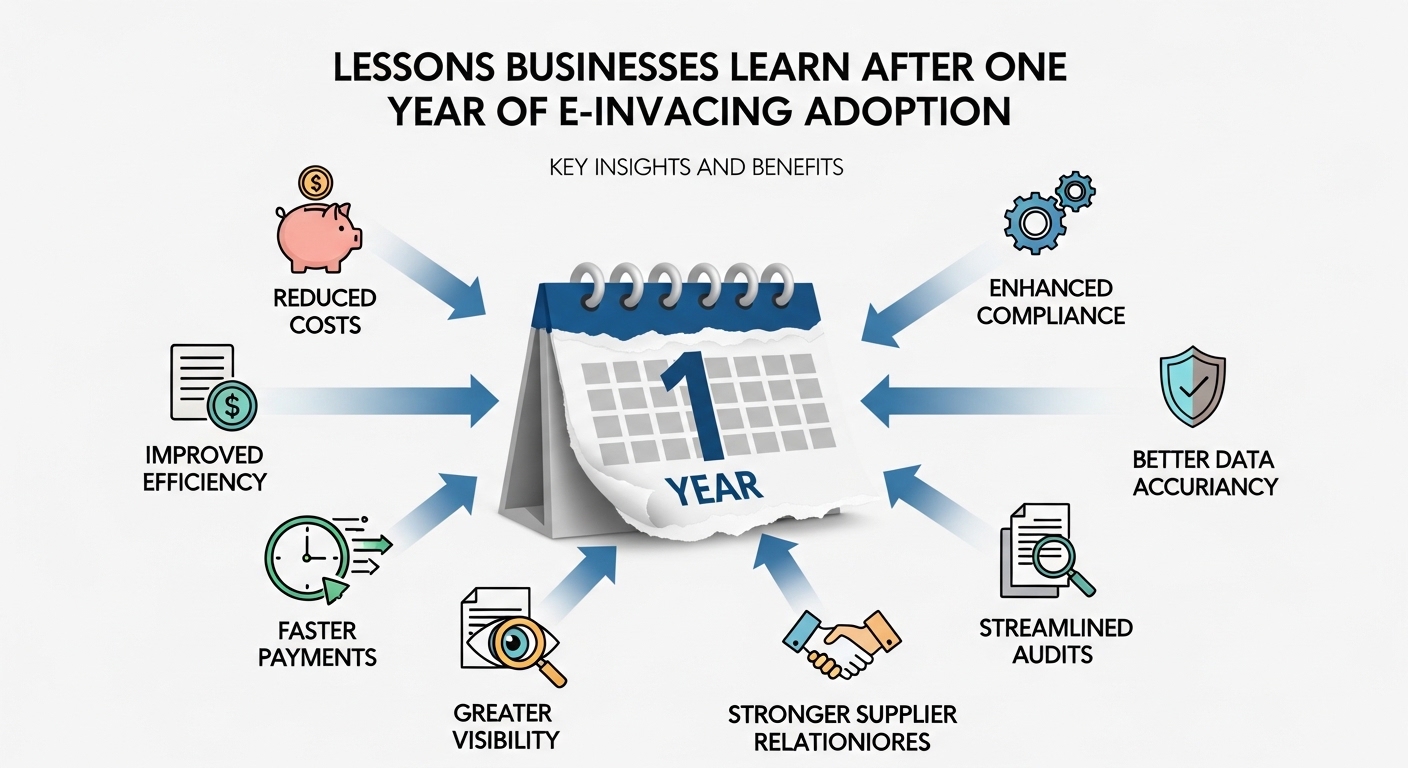
After one year, businesses often realize that the benefits of e-Invoicing are not always immediate but become visible over time.
Improvements such as:
- Better data accuracy
- Reduced manual effort
- Faster processing
- Improved reporting
collectively make a significant difference in day-to-day operations.
Conclusion
The first year of e-Invoicing adoption is a learning phase for most businesses. While the initial transition may feel challenging, the long-term benefits become clear with experience.
Businesses learn the importance of accurate data, structured processes, and consistent compliance practices. Over time, e-Invoicing becomes less of a regulatory requirement and more of a system that improves efficiency, transparency, and business confidence.
Organizations that embrace these lessons are better prepared not only for current GST requirements but also for future changes in the compliance landscape.