
ATCHAYA M
Updated on 30-07-2026
Gradually, e-invoicing has come to be commonplace within the framework of GST compliance in India. At the start of e-invoicing only the largest of organizations had been required to adopt e-invoicing. Over time, the government has altered the threshold for who must adopt e-invoicing, reduce the scope of applicability and increase the number of businesses subject to e-invoicing. Accordingly, many companies do not know whether or not they are covered under e-invoicing or how they should prepare for being covered under e-invoicing.
Understanding what the threshold for applicability is very important in that once a company has exceeded the thresholds set, e-invoicing will be required for specified transactions. If the e-invoice requirement has not been met, e-invoices will be deemed invalid under the provisions of GST.
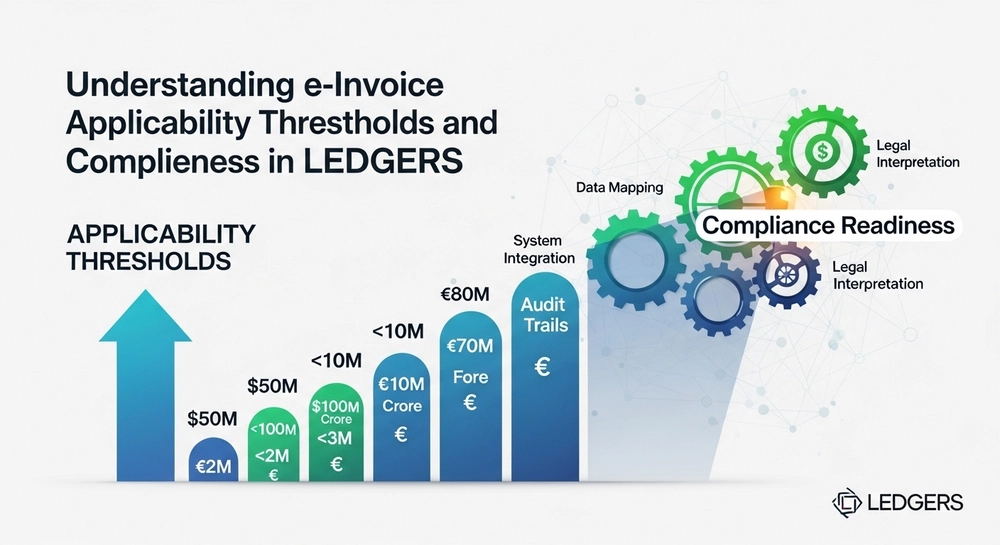
The applicability threshold refers to the annual turnover limit above which businesses must generate e-Invoices for their B2B transactions. This turnover is calculated based on total revenue from all GST registrations linked to the same PAN, not just a single branch or location.
If a business crosses the prescribed turnover limit in any financial year, it becomes eligible for e-Invoicing. From that point onward, applicable invoices must be registered with the Invoice Registration Portal (IRP) to obtain an Invoice Reference Number (IRN).
It is important to note that this requirement applies even if the current year’s turnover falls below the threshold, as eligibility is determined based on historical turnover.
Many businesses operate multiple GST registrations under a single PAN, such as separate registrations for different states. The government considers total turnover across all these registrations combined.
This means that even if one branch has low turnover, the overall organization may still fall under e-Invoicing requirements due to combined revenue.
Businesses must evaluate turnover at the organizational level rather than relying on individual registration figures.
Once a business becomes eligible, e-Invoicing generally applies to:
However, it does not apply to certain transactions such as B2C invoices. Understanding which invoices require IRN generation helps businesses avoid unnecessary compliance effort.
If a business that falls under the applicability threshold fails to generate e-Invoices properly, the invoice may be considered non-compliant under GST.
This can lead to practical issues such as:
These situations can disrupt both compliance and business operations.
Businesses often wait until e-Invoicing becomes mandatory before preparing for it. This can create operational pressure, especially when teams are unfamiliar with IRN generation and compliance workflows.
Preparing early helps businesses:
Early readiness reduces disruption when compliance becomes mandatory.
Moving to e-Invoicing involves certain process adjustments. Businesses may need to ensure that:
These changes improve overall invoicing discipline.
Businesses should regularly monitor their turnover to determine whether they are approaching the applicability threshold. Waiting until the limit is crossed without preparation can create compliance risks.
Periodic review helps organizations plan system readiness and staff training in advance.
Although e-Invoicing introduces new requirements, it also helps improve business efficiency over time. Once businesses adopt structured invoicing processes, they experience benefits such as:
Compliance readiness becomes part of normal operations rather than an extra burden.
Understanding e-Invoice applicability thresholds is essential for every GST-registered business. As turnover grows, businesses must be prepared to follow e-Invoicing requirements and generate IRN for eligible transactions. Waiting until compliance becomes mandatory can create unnecessary operational stress.
By monitoring turnover, maintaining accurate billing data, and preparing internal processes in advance, businesses can transition smoothly into e-Invoicing. Being proactive ensures compliance continuity and helps organizations maintain reliable and efficient GST operations as regulatory requirements evolve
