
PUGALENTHI
Updated on 30-07-2026
E-commerce has revolutionized the way businesses operate, extending their market reach far beyond traditional boundaries. However, for online sellers in India, navigating the country's Goods and Services Tax (GST) landscape can be complex. GST compliance is no longer optional; it's mandatory for businesses engaging with e-commerce platforms. This article will guide e-commerce sellers on how to handle GST efficiently, with a focus on simplifying the process through understanding key concepts and leveraging automation tools.
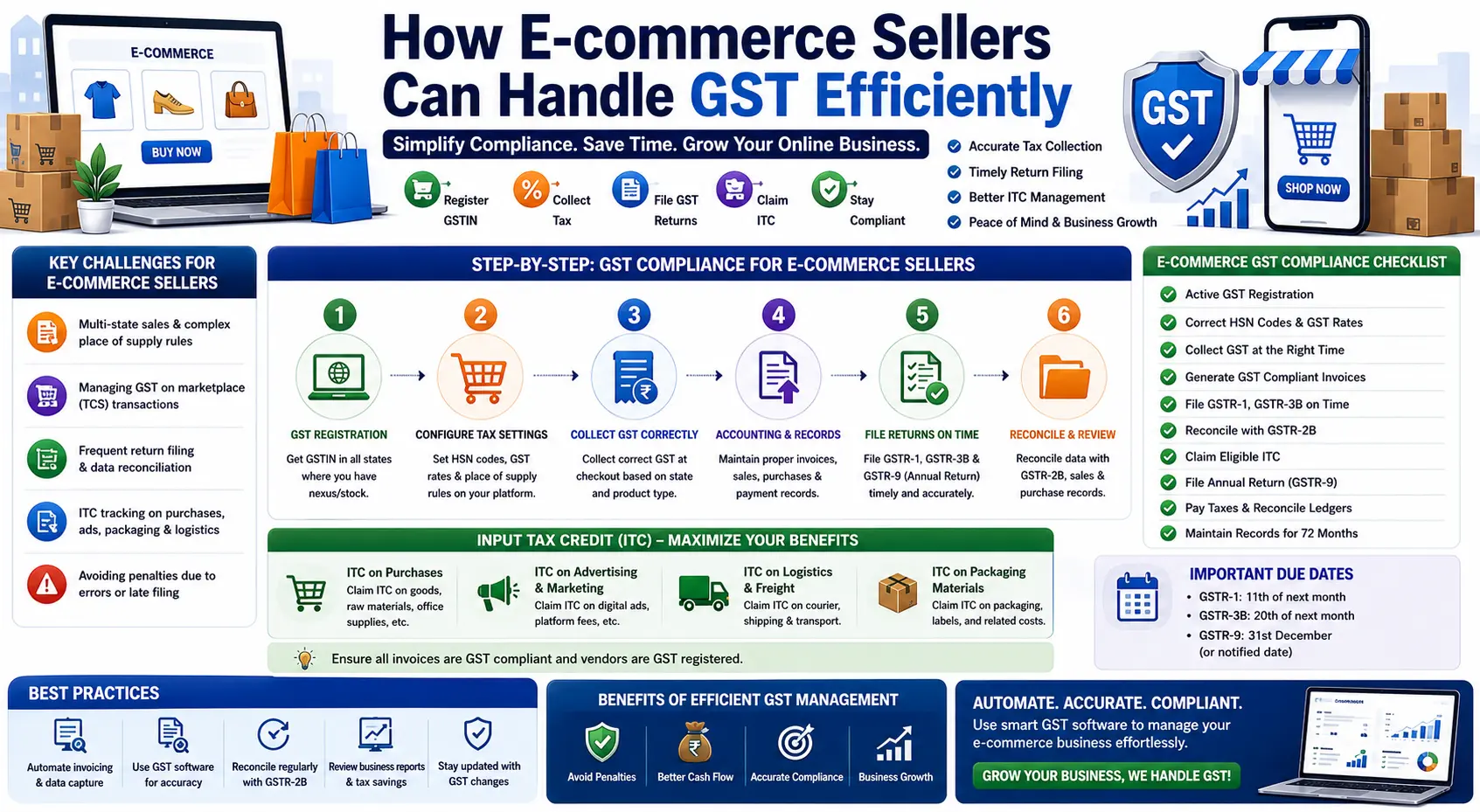
The applicability of GST for e-commerce businesses involves several layers of compliance, making it more complex than for traditional business models. For online sellers, GST compliance is complicated by factors such as Tax Collected at Source (TCS), multi-state operations, and high transaction volumes. Let's explore why GST compliance is particularly challenging for e-commerce sellers and how they can manage these challenges effectively.
E-commerce sellers face unique challenges due to:
To handle GST efficiently, e-commerce sellers must grasp several essential concepts:
Online sellers must register for GST in every state where they have physical operations or a significant economic presence. This ensures compliance with local tax regulations and smooth operational flow.
TCS is a compliance requirement for e-commerce platforms where a percentage of sales is collected by the platform and remitted to the government. This ensures revenue tracking and prevents tax evasion.
Invoices must meet specific GST requirements, including details like the seller’s GSTIN, HSN/SAC codes, and the amount of tax applicable. Accurate invoicing is critical for seamless compliance and smooth operations.
Understanding Harmonized System of Nomenclature (HSN) and Services Accounting Code (SAC) is essential for classifying goods and services accurately. Incorrect coding can lead to compliance issues and penalties.
ITC allows businesses to reduce their GST liability by claiming credits for the taxes already paid on purchases. Proper ITC management helps optimize cash flow and reduce overall tax burden.
Sellers must regularly file GST returns, which can be complex due to the multiple forms required (e.g., GSTR-1, GSTR-3B). Timely and accurate filing is critical to avoid penalties.
Ensuring that data between sales reports and GST filings match is crucial for compliance. Reconciliation helps prevent discrepancies that could attract audits or penalties.
Let's explore practical examples of GST compliance in action:
Sellers on platforms like Amazon or Flipkart must account for TCS deductions on every transaction, necessitating precise record-keeping and regular reconciliation.
Direct-to-consumer brands with multi-state operations face unique challenges with multiple GST registrations, requiring careful management of individual state compliance requirements.
For those selling across several platforms, maintaining consistency in invoicing and reconciling marketplace data becomes imperative to prevent compliance violations.
E-commerce sellers often encounter issues such as:
Leveraging automation tools and software can significantly alleviate compliance burdens. Benefits include:
Automation solutions ensure accurate invoicing and seamless calculation of GST liabilities.
Automated systems handle the complexities of return filing, ensuring timely submissions and reducing the risk of errors.
Tools can automatically reconcile TCS amounts deducted by marketplaces, simplifying financial alignment.
Track and claim input tax credits efficiently to optimize cash flow.
To ensure smooth GST management:
Handling GST efficiently is crucial for e-commerce sellers aiming to grow their business in India. Understanding key GST concepts and leveraging automation tools can significantly simplify compliance, reduce operational burdens, and enhance overall efficiency. By adopting best practices and staying informed about regulatory changes, online sellers can ensure seamless operations and focus more on business growth.
Remember, the complexity of e-commerce GST compliance doesn't have to be a hurdle. With the right knowledge and tools, you can navigate this landscape with confidence and agility.
LEDGERS assists with compliance relating to GST through the integration of reconciliations into your accounting processes to allow the speedy identification of errors in records prior to incurring any penalties or interest. LEDGERS allows you to automate the process of synchronizing your GSTN data and tracking invoices on an invoice-by-invoice basis eliminating the need for manual corrections and the time-consuming process of verifying transactions at the end of a reporting period through the use of automatic validations from the system to facilitate revenue compliance activities.
